
Key Takeaways
- A beneficiary designation on file overrides your will for that asset in most cases. The institution pays the named person regardless of what your will says.
- Most household wealth sits in retirement accounts and life insurance that pass by beneficiary designation, not by your will.
- Never name minor children directly on a life insurance policy or retirement account. It triggers court-supervised guardianship instead of the trust arrangement most parents intend.
- Update beneficiary designations after every marriage, divorce, birth, or death, and review your entire plan every three to five years.
- You need both a will and current beneficiary designations working together.
*Written by Jay Hamilton, Father & Real Estate Attorney, Arbor Legacy Lawyers P.C.* With a client-first approach and a focus on clear communication, Jay guides individuals, families, and businesses through residential and commercial real estate closings, business law, and estate planning. A husband and father himself, Jay creates tailored solutions that reflect each client's unique family dynamics, helping them protect what matters most through Arbor Legacy's life and legacy planning model.
A Chattanooga widow opens her late husband's life insurance policy expecting the payout the couple always talked about, and discovers the form still names his ex-wife from a marriage that ended a decade ago. The will leaves everything to her. It does not matter. The insurance company pays the name on the form, and no Hamilton County courtroom will undo it. This situation is more common than most families realize and entirely preventable with a straightforward review of your designations. This is the heart of the beneficiaries vs will question, and it decides where most of your wealth actually goes. This article explains which document controls which assets, the mistakes that cost families money, and how keeping the people you love out of court and out of conflict starts with getting these details right.
Why Beneficiary Designations and Wills Are Not the Same Thing
Two documents govern where your money goes, and most families never learn how they interact until a loved one has died.
What a Will Actually Controls
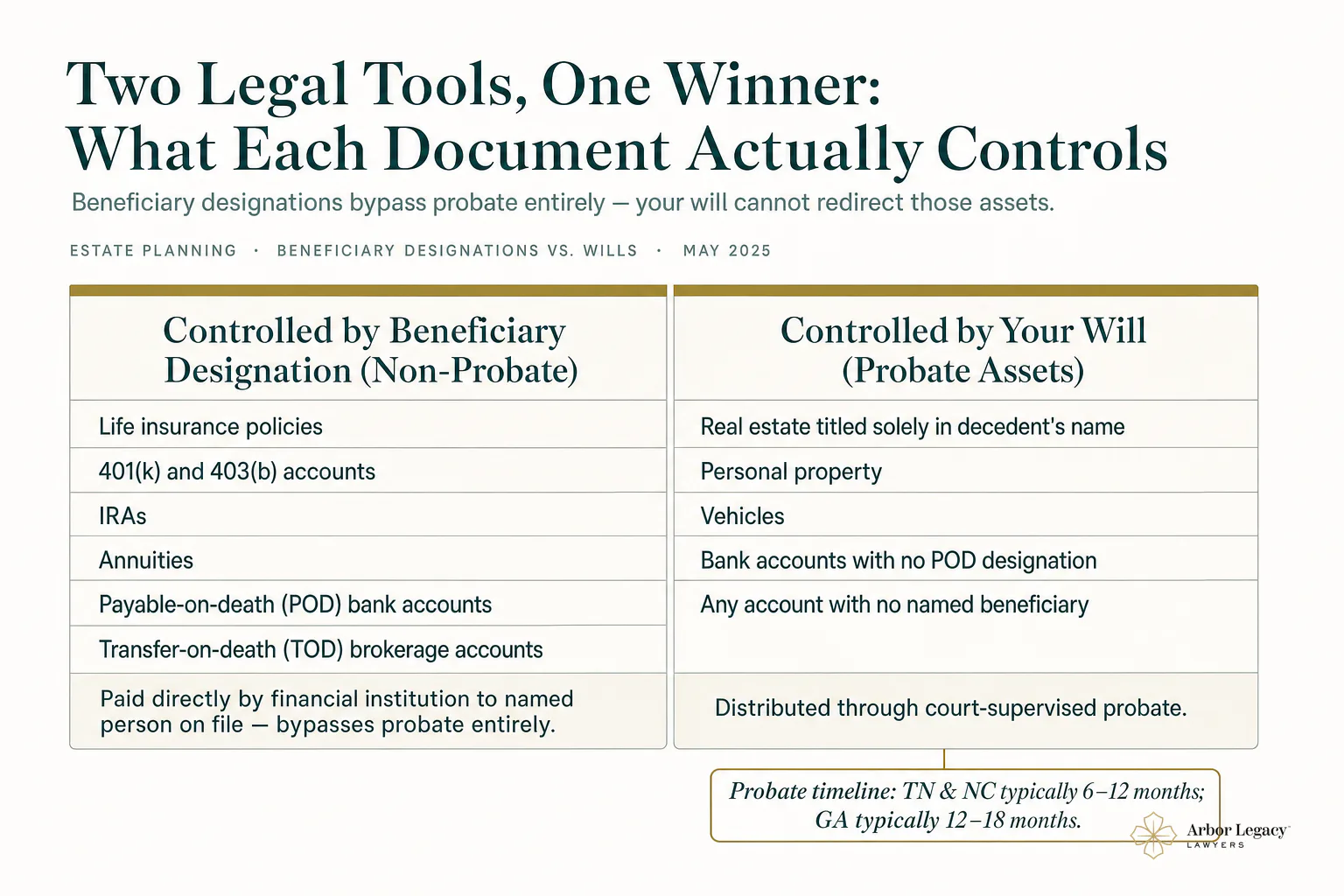
A will directs how your probate assets are distributed after death. Probate assets are things titled solely in your name with no named beneficiary, like a house owned alone, a car, or bank accounts without a payable-on-death designation. For a straightforward, uncontested estate, probate in Tennessee, North Carolina, and Georgia generally takes about a year, according to Georgia Legal Aid, though it can take as little as a few months or as long as several years depending on estate complexity, creditor claims, and disputes. If you are weighing which tool fits, our guide on wills versus trusts breaks down the tradeoffs.
What a Beneficiary Designation Actually Controls
A beneficiary designation is a legal document filed directly with a financial institution or insurance company. It travels with the account, not the will, and governs life insurance policies, retirement accounts like 401(k)s and IRAs, and payable-on-death bank accounts. Those assets transfer outside probate entirely, according to Citizens Bank. That is why beneficiary designations can put your family at risk when they drift out of date.
The Legal Hierarchy That Surprises Most Families
Estate law generally puts beneficiary forms first in order of precedence, ahead of any direction in a will for that same account, as Paramus Estate Planning explains. The financial institution follows the form on file.
Do Beneficiaries Override a Will in Every Situation
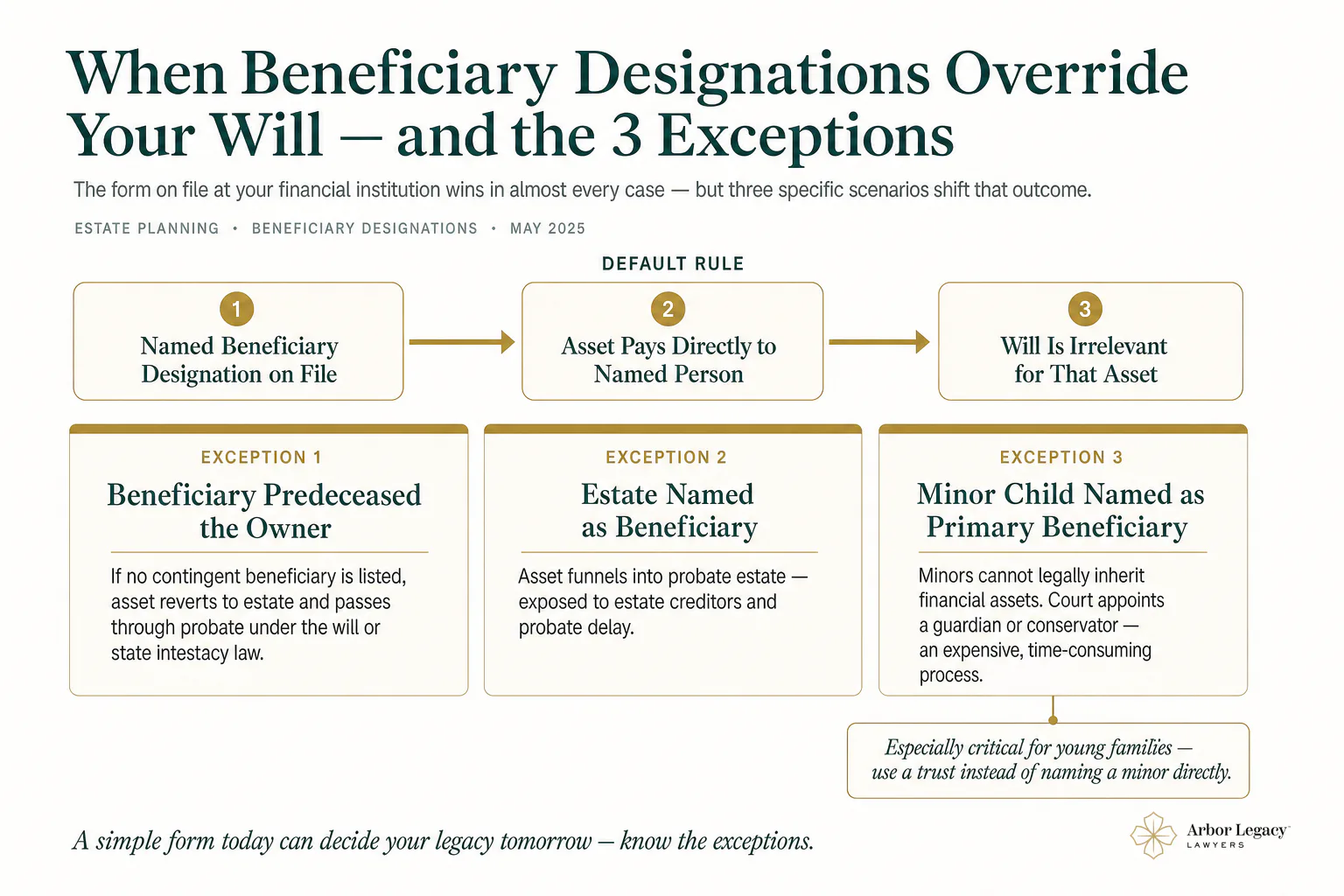
For assets with a beneficiary designation on file, the named beneficiary takes precedence over the will in most cases. There are important exceptions.
The Short Answer and the Rule Behind It
In the great majority of routine cases, yes. Financial institutions pay the designated beneficiary on file regardless of what the will instructs. If your will and beneficiary form conflict, the form usually controls, though exceptions apply when a trust is named as beneficiary or state law revokes a designation upon divorce, so review both together. In many states, divorce automatically revokes a designation to a former spouse on certain other assets as well.
The Exceptions That Can Shift the Outcome
Several situations complicate the rule. First, if the one beneficiary named predeceased the account holder and no contingent beneficiary is listed, the asset reverts to the estate and passes through probate. Second, if the estate itself is named as beneficiary, the funds funnel into probate court, according to LegalZoom. Third, naming a minor child directly triggers court-supervised guardianship. Beyond those, a court may find the designation does not reflect the owner's true intent, and some states automatically revoke a designation to an ex-spouse upon divorce. Listing contingent beneficiaries on every account eliminates the most common failure point.
What Happens When There Is No Beneficiary Named at All
Without a named beneficiary, the asset becomes a probate asset governed by the will or, absent a will, by state intestacy laws. In Tennessee, Georgia, and North Carolina, intestacy laws follow a statutory order that may not reflect your wishes.
Which Assets Are Controlled by Beneficiary Designations vs Your Will
Match your asset inventory to the correct legal mechanism, and the picture gets clear fast.

Assets That Always Transfer by Beneficiary Designation
Life insurance policies, employer-sponsored retirement plans, IRAs, annuities, and payable-on-death or transfer-on-death accounts are non-probate assets. Total U.S. retirement assets reached about $40 trillion in mid-2024 and $47.6 trillion by early 2026, according to the Investment Company Institute. IRAs alone held $19.2 trillion at year-end 2025, per ICI. For most families, the majority of financial wealth passes outside the will.
Assets That Typically Pass Through Your Will
Real property titled solely in one name, vehicles, personal property, and other assets such as accounts with no beneficiary designation pass through your will. Certain assets held as joint tenants with right of survivorship pass automatically to the surviving owner, while property held as tenants in common lets a will govern each owner's share.
The Gray Zone Assets Families Fight Over
Old retirement accounts, forgotten life insurance policies from former employers, and vague designations cause common beneficiary mistakes. Pull every beneficiary designation on file and compare it against your current wishes.
The Costliest Mistakes Families Make When Mixing Wills and Beneficiary Designations
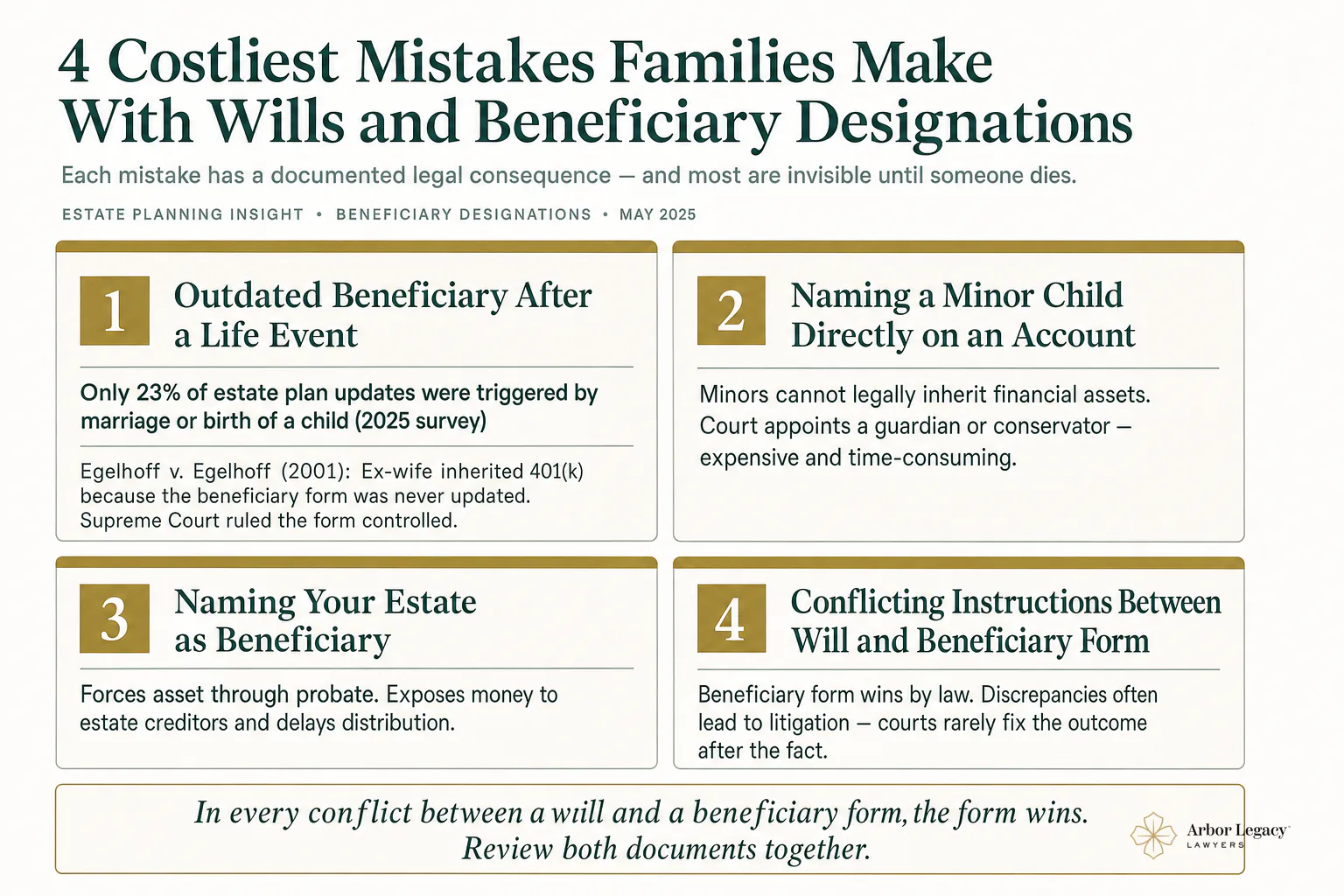
These four mistakes cause families to lose money, damage relationships, and undermine the values and wishes the deceased meant to pass on — and most are preventable when estate planning is treated as an ongoing relationship rather than a one-time document purchase.
Forgetting to Update Designations After Major Life Events
Marriage, divorce, the birth of a child, and the death of a prior beneficiary are the events most likely to derail a designation. In Caring.com's 2025 study, 23% of people who updated their plans did so to accommodate a birth or marriage. In Egelhoff v. Egelhoff (2001), a man's 401(k) still named his ex-wife after divorce, and she legally inherited it, per Cornell Law School. Federal law (ERISA) governs employer plans differently than state laws govern insurance, so schedule a review after major life changes.
Naming a Minor Child Directly on Accounts
When minor children are named directly on a policy or retirement account, a court must appoint a guardian to manage the funds until adulthood, according to SmartAsset. It is expensive, requires ongoing court involvement, and is the opposite of what parents intend. Naming a trust instead keeps control with the trusted adult you chose. This is the heart of Kids Protection Planning — ensuring your children are raised by the people you choose, not a stranger appointed by a court. The same logic is why leaving a pet in your will will not protect them.
Conflicting Instructions Between the Will and Beneficiary Forms
The classic version is a will leaving everything to a current spouse while an old life insurance policy still lists a sibling or ex-partner. The will cannot override the form, and these discrepancies can become a source of litigation. In most conflicts the form on file controls, though exceptions apply when a trust is named or state law revokes a designation upon divorce — a rule recognized in many states. Treat the will and all beneficiary designations as one coordinated system, reviewed every three to five years.
Is It Better to Have a Beneficiary Designation or a Will
This is a false choice. A functional estate plan uses both tools strategically.
Why the Question Itself Points to a Common Misunderstanding
A last will governs probate assets and captures instructions no beneficiary form can, like guardianship of minor children, funeral instructions, and specific bequests. Beneficiary designations govern financial accounts. Will ownership dropped from 31% of Americans in 2025 to 26% in 2026, and more than half of adults have none of the core estate-planning documents, according to Trust & Will's 2026 Estate Planning Report. A separate Caring.com survey put will ownership at 24%. Meanwhile about 63% of adults hold a retirement savings account, per Gallup, most with a beneficiary designation attached. The real question is whether they work together. For a deeper walk through the basics, see our overview of wills and trusts.
When a Revocable Living Trust Becomes the Better Solution
For families whose goal is keeping loved ones out of court and conflict, a revocable living trust becomes the central coordination tool. The trust is named as beneficiary on accounts and holds title to property, so everything flows through one set of instructions with no probate. This is especially valuable for families with property in multiple states, blended families, a child with special needs, or other family members with asset protection planning concerns. For older adults, elder law planning considerations — such as Medicaid eligibility and long-term care — can also shape how a trust should be structured. Our comparison of creating a trust in your will versus a living trust explains how the approaches differ.
How to Make Sure Your Beneficiary Designations and Will Actually Align
Coordination is the difference between a plan that works and a pile of documents that fights itself.

How to Name a Beneficiary and What Information You Need
To name or update a beneficiary, contact the institution or plan administrator and request a beneficiary designation form. You will need the beneficiary's full legal name, Social Security number, date of birth, and relationship to you. Name both a primary beneficiary and at least one contingent beneficiary on every account, and consider naming multiple beneficiaries by specifying percentages when naming multiple people.
What an Estate Planning Review Should Cover
A complete review looks at the will, all beneficiary designations, asset titling, powers of attorney, and healthcare directives, along with other documents such as trust agreements, together — and a financial advisor can help ensure nothing is overlooked, including whether an estate tax return may be required. Experts recommend a review every two years at minimum, or every three to five years for most families, plus an immediate update after any major life events. Age matters too, even among adults in their 60s, only 46% have a will, according to Pew Research Center. Give your estate planning attorney a list of every account and policy you own. If you are just starting, our estate planning FAQs answer the questions families ask most.
Frequently Asked Questions About Beneficiaries vs Wills
Do beneficiaries override a will?
In most cases yes, per Citizens Bank. Exceptions include when the beneficiary predeceased the owner with no contingent named, when the estate is named, or when a trust is the named beneficiary.
What are the cons of being a beneficiary?
Inheriting can trigger taxes. Most non-spouse beneficiaries of inherited IRAs must empty the account within 10 years under the SECURE Act, according to Mercer Advisors, which can push you into a higher bracket. Inherited assets may also lack creditor protection.
Who should I not name as a beneficiary?
Avoid naming minor children directly, per LegalZoom, and avoid naming your estate, which forces probate. Individuals with special needs can lose Medicaid or SSI eligibility if they inherit directly, so use a Special Needs Trust.
Is it better to have a beneficiary designation or a will?
You need both. A will handles probate assets and names who raises your minor children, beneficiary designations handle financial accounts and transfer them faster without probate.
What happens to accounts with no beneficiary named?
They typically become probate assets, passing according to the will or, absent one, state intestacy laws that may not match the deceased's wishes.
What to Do Right Now So Your Family Gets What You Intend
Most families keep their wealth concentrated in accounts controlled by beneficiary designations, not wills — and the beneficiaries vs will question is one many people have never thought through carefully enough to verify those designations are current. A simple review ensures the people you love receive what you intend — and avoids a situation no court can undo. Arbor Legacy's Life & Legacy Planning model is an ongoing relationship that evolves with your family — not a one-time session or document review — and it brings together your will, beneficiary designations, asset titling, and family protection needs as one unified, living plan. Matthew "Web" W. Raulston, an estate planning attorney at Arbor Legacy Lawyers, helps families across Tennessee, Georgia, and North Carolina do exactly that. This level of coordinated planning guidance is usually reserved for very high net worth families — Arbor Legacy makes it available to everyone, with transparent, no-surprise pricing. Get started with Arbor Legacy Lawyers and give the people you love a plan that actually works.
This article is a service of Arbor Legacy Lawyers P.C. and is provided for general informational purposes only. It does not constitute legal advice and does not create an attorney-client relationship. Estate planning laws vary by state; consult a qualified attorney about your specific situation.
Jay Hamilton, Father & Real Estate Attorney, Arbor Legacy Lawyers P.C.