
Key Takeaways
- A will does not avoid probate. It is a set of instructions for the probate court, and any asset owned solely in a person's name still goes through the legal process.
- Non-probate assets like life insurance, retirement accounts, and jointly owned property pass directly to named beneficiaries without court involvement.
- A properly funded revocable living trust is the most complete tool for keeping an entire estate out of probate court.
- Probate can consume 3% to 8% of an estate's gross value and take 16 to 20 months nationally before heirs receive anything, though simple estates can close in far less time.
- Small estate thresholds differ across Tennessee, Georgia, and North Carolina, so the right plan depends on where you live.
*Written by William Mone, Family & Estate Planning Attorney, Arbor Legacy Lawyers P.C.* William works with individuals, families, and business owners, delivering practical guidance tailored to their goals. His practice spans real estate, small business law, family law, estate planning, and probate. With a steady approach and clear communication, he builds strategies that provide clarity and stability, helping clients protect what matters most through Arbor Legacy's life and legacy planning model.
In Hamilton County and other Tennessee counties, families are often surprised to find that a signed will does not mean the house and bank accounts pass to them quickly — and that there are straightforward steps they can take now to avoid that outcome entirely. The will does not spare them the process, it simply tells the court what to do once probate is over. So do wills have to go through probate — or, put another way, do all wills go through this legal process? In most cases, yes. This article explains when a will triggers the probate process and maps out the strategies that keep your loved ones out of court and out of conflict — and out of probate court entirely.
Do Wills Have to Go Through Probate: Why a Will Does Not Automatically Avoid It
The biggest misconception about a last will and testament is that it keeps your family out of court. Families often need legal advice to understand that the last will actually triggers the very process they hoped to avoid. It does the opposite. A last will is a set of instructions for the probate court, not a way around it. Think of it like a GPS, the will tells everyone the destination, but the probate process is still the road your family has to travel.
 A Will Sends Your Estate to Probate Court — Here Is What That Costs — Source: probatebystate.com; settledestate.com; fhfunding.com; caring.com; bankingjournal.aba.com
What Probate Actually Does to a Deceased Person's Estate
Probate is the court-supervised legal process that validates the will, appoints a personal representative, pays creditor claims, and transfers title to heirs as part of estate administration. Nationally, the average formal probate takes about 16 to 20 months from filing to final distribution, according to Probate by State. Simple, uncontested estates can close in three to six months, while contested estates can run several years. For a typical estate, probate costs often consume 3% to 8% of gross value, per Settled Estate, meaning a $500,000 estate can lose roughly $15,000 to $40,000 before anyone inherits. Working with the right lawyer before death is what keeps families from ever landing there.
Why Having a Will Does Not Equal Having a Plan
Only about 34% of Americans have any estate planning document at all, according to Caring.com's 2023 study, with just 32% reporting a will in 2024. Even among those who plan, most stop at a will, leaving the family exposed to probate court, a public record of assets, and potential conflict. A will is the starting point of a living plan that grows with your family — not a one-time document purchase. The real goal is an ongoing relationship that evolves as your life changes, covering far more than paperwork. For a broader picture, see this overview of wills and trusts.
Which Assets Have to Go Through Probate and Which Ones Do Not
The question most families really want answered is whether their house, bank accounts, or retirement accounts have to go through probate. The dividing line is simple, does the asset have a built-in mechanism, a named beneficiary, a joint owner with survivorship rights, or a trust, that transfers it outside the probate estate?
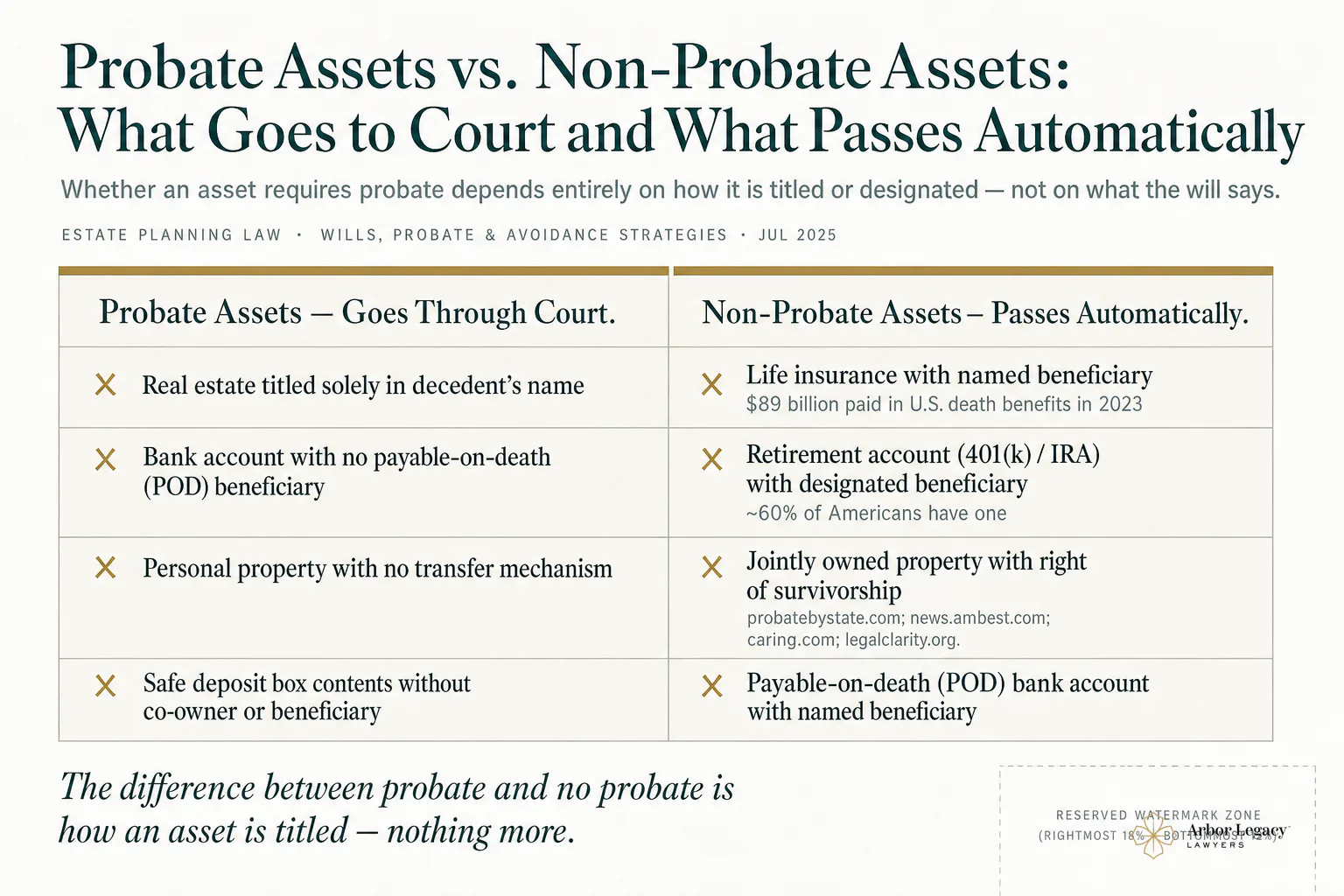 Probate Assets vs. Non-Probate Assets: What Goes to Court and What Passes Automatically — Source: wa-probate.com; probatebystate.com; news.ambest.com; caring.com; legalclarity.org
Probate Assets That Get Stuck in Court
Decedent probate assets are those owned solely in the decedent's name with no beneficiary or survivorship provision. Common examples include real estate titled solely in the decedent's name, bank accounts without designated beneficiaries, business interests, and personal property such as jewelry, artwork, and furniture. Real property is one of the most frequent probate triggers because ownership does not pass automatically at death without proper planning.
Non-Probate Assets That Pass Automatically
Non-probate assets, sometimes called nonprobate property, transfer directly to a beneficiary or co-owner by operation of law. Life insurance policies with a named beneficiary, retirement accounts such as IRAs and 401(k)s with designated beneficiaries, jointly owned property with right of survivorship — including joint tenancy with the surviving owner taking title automatically — and joint bank accounts all skip probate. The U.S. life insurance industry paid roughly $89 billion in death benefits in 2023, according to AM Best, and those funds went straight to named beneficiaries rather than through any estate.
How State Law in Tennessee, Georgia, and North Carolina Shapes the Probate Process
The basic probate process looks similar across states, but each one sets its own thresholds for small estate shortcuts, its own deadlines, and its own court costs. The probate process can look very different depending on where the decedent lived.
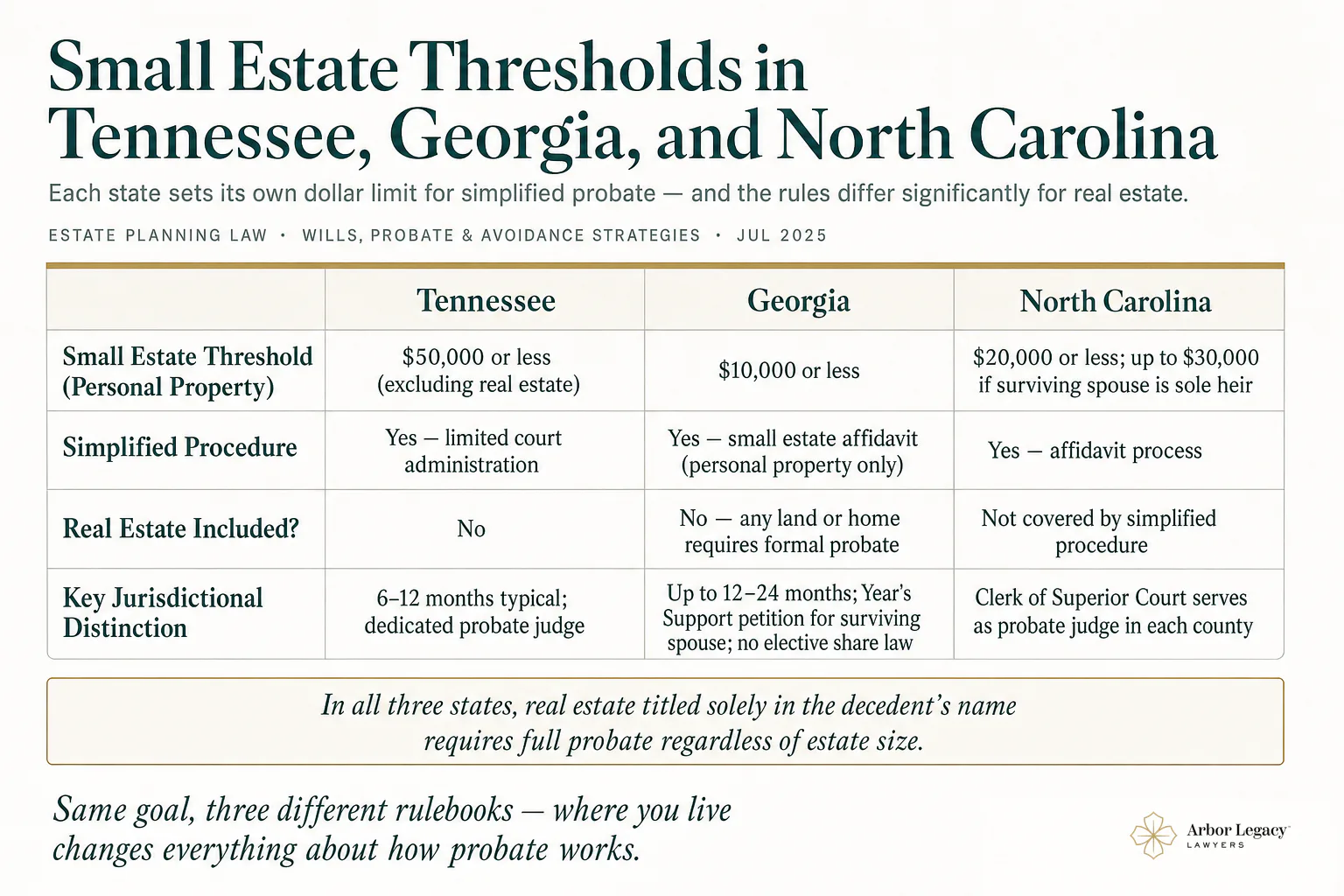 Small Estate Thresholds in Tennessee, Georgia, and North Carolina — Source: law.justia.com; legalclarity.org; ncleg.gov; probatebystate.com; dconc.gov; settledestate.com
Tennessee Probate for Families in Chattanooga and Franklin
Under Tennessee Code § 30-4-102, a small estate means probate-eligible personal property worth $50,000 or less, excluding real estate. The estate is opened in the county of the decedent's legal domicile, so a Franklin resident's estate goes through Williamson County. Petitions can generally be filed 45 days after death. Families under the small estate threshold may use the simplified probate process or avoid formal probate court entirely.
Georgia and North Carolina Rules for Alpharetta, Trenton, and Blue Ridge
In Georgia, many counties offer a small estate affidavit that heirs can use to collect estate property when the estate is worth $10,000 or less and contains only personal property, not real estate Legal Clarity. Georgia also offers a Year's Support petition that lets a surviving spouse and minor children set aside property to cover support for the first 12 months after death, taking priority over most debts Settled Estate. North Carolina permits a small estate affidavit when personal property is under $20,000, or up to $30,000 if a surviving spouse is the sole heir, per the North Carolina General Statutes. There, the Clerk of Superior Court serves as the probate judge and indexes those affidavits.
The Most Effective Ways to Keep Your Family Out of Probate Court
Every one of these tools must be set up before death, because none work retroactively. Structuring assets correctly now is how you keep your loved ones out of court and out of conflict later.
 Four Strategies That Keep Your Family Out of Probate Court — Source: probatebystate.com; news.ambest.com
A Revocable Living Trust Transfers Everything Without Court Involvement
A revocable living trust holds your assets during your lifetime and transfers them directly to beneficiaries at decedent death, with no probate court required. The catch is funding, assets must actually be retitled into the trust. Forget to move your vacation home in the North Georgia mountains into the trust, and that home still lands in probate. A funded revocable living trust is the most comprehensive single tool for probate avoidance, and a trust set up without proper legal help often leaves families with an expensive mess.
Beneficiary Designations and Joint Ownership as Targeted Fixes
Payable-on-death designations on bank accounts, transfer-on-death registrations on brokerage accounts, and right-of-survivorship titling on real property — available for joint tenants as well as sole owners — solve probate exposure asset by asset without a full trust. These tools are free to set up and effective immediately. The danger is that they go stale, a 401(k) still naming an ex-spouse will override your will. Review beneficiary designations after any divorce, death, or birth of a child. This is why an estate plan review matters as much as the original setup.
What Happens When There Is No Will and No Plan at All
Dying without a will does not send your assets to the state. It hands the decision to a rigid statutory formula that rarely matches your actual wishes.
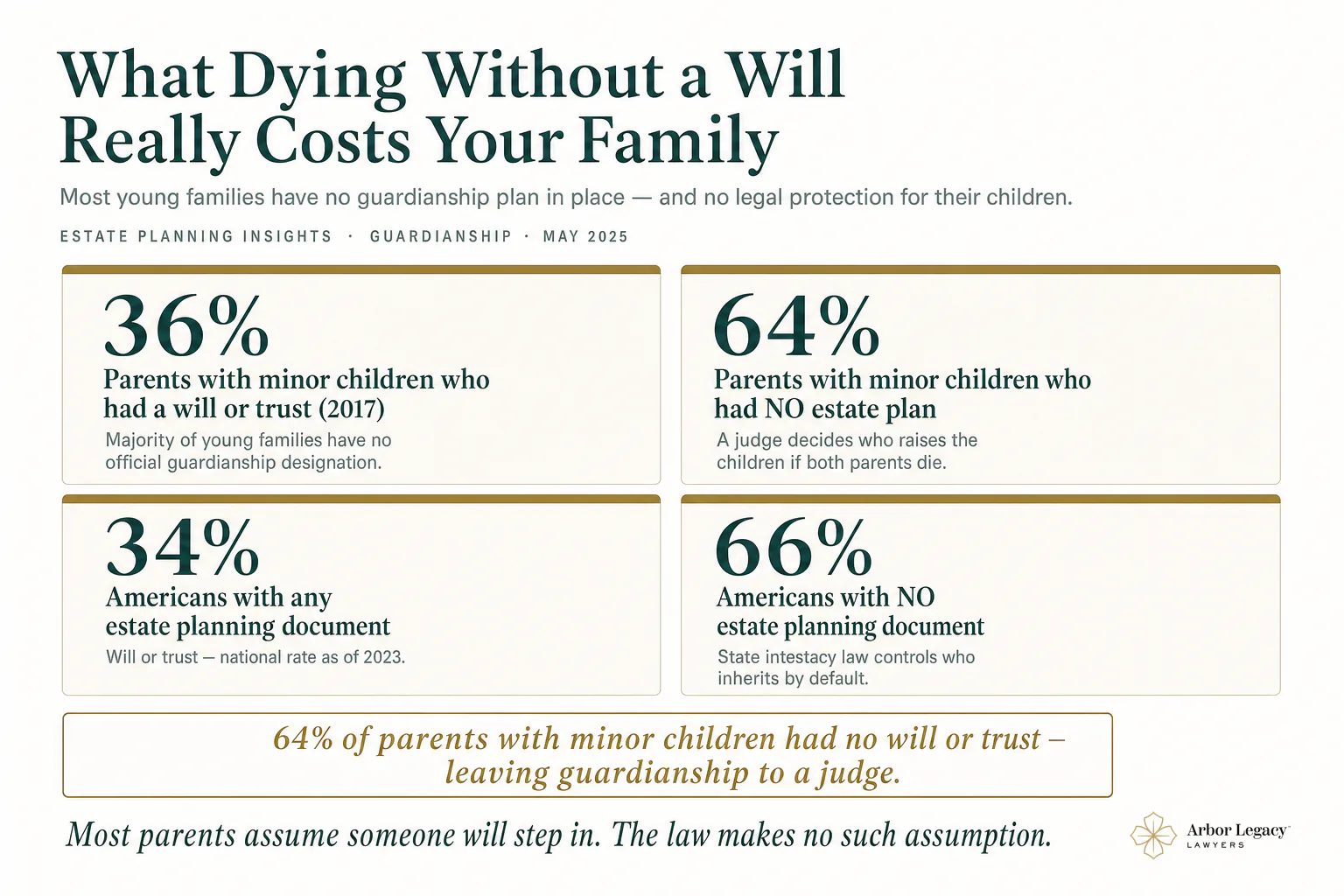 What Dying Without a Will Really Costs Your Family — Source: PRNewswire / LegalZoom Survey, 2017; Caring.com 2023 Wills & Estate Planning Study
Intestate Succession Means the State Decides Who Gets What
Think of intestate succession as the state's default rulebook — the one that applies when you haven't written your own. It rarely matches how real families actually work. Most state laws set the distribution order, usually spouse first, then children, then other family members. In Georgia, a surviving spouse and children each take an equal share, though the spouse never receives less than one-third, according to Settled Estate. This rule applies only to the probate estate. Intestacy never recognizes unmarried partners or stepchildren, so a long-term partner can inherit nothing. The formula ignores your real relationships, which is why blended families need estate planning tailored to who they actually are.
No Plan Also Means No Say Over Who Raises Your Children
If both parents of a minor child die without naming a guardian in a legal document, a judge decides who raises that child. As of 2017, only 36% of parents with children under 18 had a will or living trust, according to PR Newswire. Kids Protection Planning is Arbor Legacy Lawyers' signature service for families with minor children — ensuring your kids are raised by the people you choose, with a plan that is legally sound and personally meaningful, not left to a court's judgment.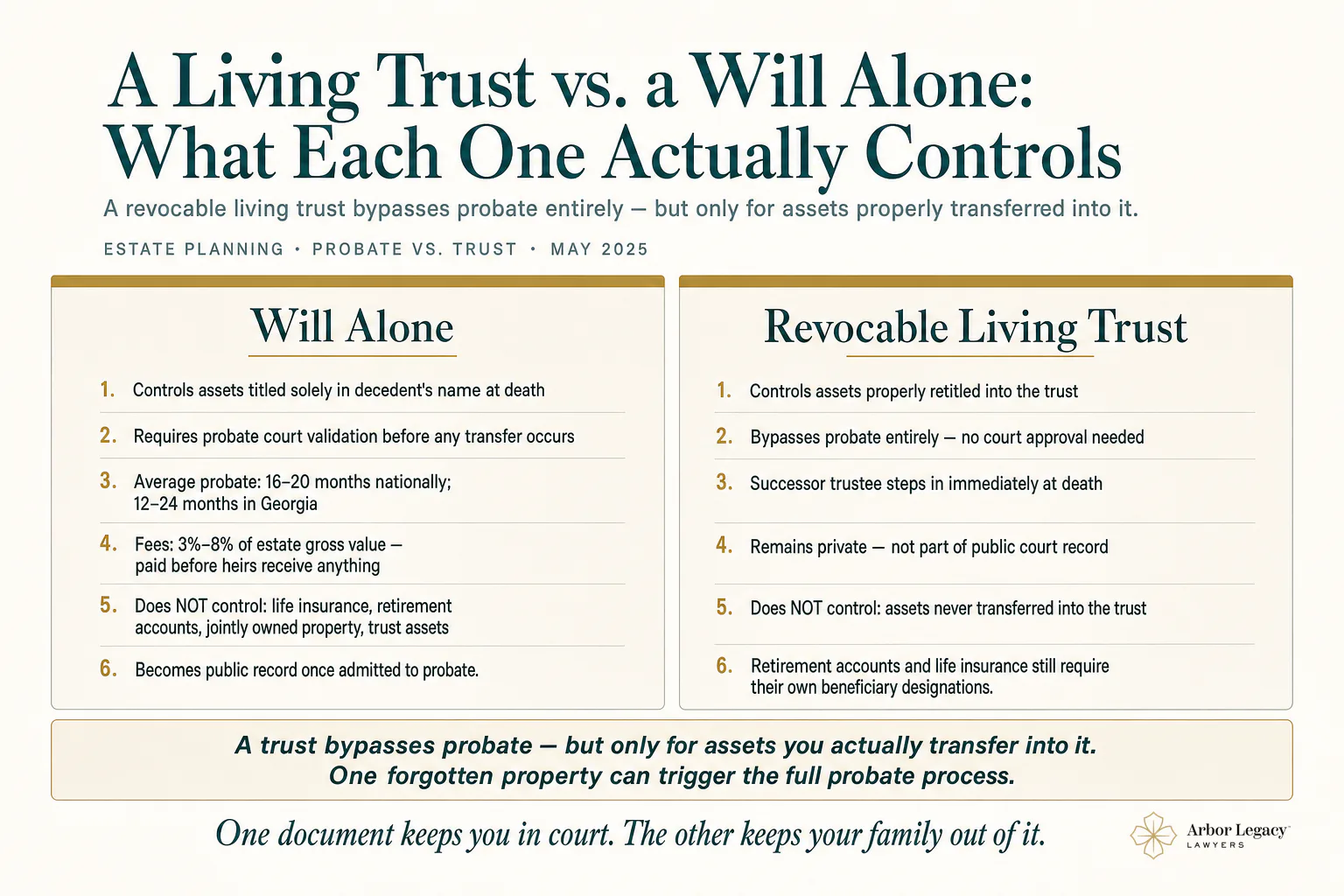 A Living Trust vs. a Will Alone: What Each One Actually Controls — Source: probatebystate.com; settledestate.com — Probate Costs Explained
The Real Cost of Probate That Most Families Do Not Anticipate
Probate is not a minor administrative step. Its costs are both financial and relational, and families rarely see either coming until they are inside the process.
Court Fees, Attorney Fees, and the Time Delay That Freezes Assets
Total probate costs, including attorney and executor fees, court filing fees, and appraisal and publication charges, typically consume 3% to 7% of the gross estate value for a routine estate, according to Probate by State. On a $400,000 estate, that is roughly $12,000 to $28,000, all coming out before heirs receive anything. In Tennessee, attorney fees for a typical estate often run from about $2,000 to $7,500 with court costs of $500 to $1,000. During probate, a house may sit vacant and bank accounts may be frozen pending court approval, leaving a surviving spouse or children without access to money they need.
How Probate Becomes a Conflict Trigger for Family Members
Probate is public. The will and the inventory of estate assets become part of the court record, so creditors and estranged relatives can scrutinize the estate and file claims. Disagreements that might have stayed private turn into formal will contests — the kind of legal issues that a neutral third party might otherwise help resolve. Only a small share of estates end up in litigation, but those that do can see legal fees climb into the tens of thousands. Getting a reluctant partner involved early matters, which is why knowing what to do when your spouse won't get on board with estate planning can prevent this outcome.
Frequently Asked Questions
How do you know if a will needs to be probated?
A will generally needs probate when the deceased owned assets solely in their own name with no beneficiary or joint owner. Inventory the assets and check how each is titled.
What is the biggest mistake with wills?
Treating a last will as a complete estate plan. A last will only controls probate assets and has no authority over life insurance, retirement accounts, or trust property.
Who is exempt from probate?
Exemption applies to assets, not people. Life insurance and retirement accounts with named beneficiaries, jointly owned property, and assets in a funded trust are all exempt. Small estates below state thresholds may use a simplified affidavit.
Can you execute a will without probate?
In most cases, no. A will has no legal force until a probate court admits it, unless every asset passes through beneficiary designations, joint ownership, or a trust. If you still have questions, the firm keeps a running list of answers to common ones.
What happens if you don't probate a will in Tennessee?
Tennessee law expects a last will to be filed within a reasonable time after decedent death. Failing to do so can leave real estate with a clouded title, expose heirs to creditor liability, and lock the family out of assets.
A Living Plan Protects Your Family Where a Will Alone Cannot
Most wills do go through probate, but probate is not inevitable. It is the result of assets that were never structured to pass another way. Families who fund a living trust, keep beneficiary designations current, and title real property correctly can spare their loved ones the cost, delay, and conflict of probate court — keeping the people they love out of court and out of conflict. This kind of planning is about more than protecting financial assets; it is about passing on values, relationships, and the stories that define your family. A legacy is not just a balance sheet — it is the priorities, relationships, and stories you leave behind. This level of guidance is usually reserved for high-net-worth families, but Arbor Legacy Lawyers makes its estate planning services available to every family — with transparent, no-surprise pricing.
William Mone, one of the estate planning lawyers at Arbor Legacy Lawyers, works with families across Tennessee, Georgia, and North Carolina using a Life & Legacy Planning model — an ongoing relationship, not a one-time document. That relationship covers the full range of planning needs, from asset protection planning and guidance from elder law attorneys to special needs planning and business planning. As life changes, whether that means a marriage, the birth of a child, a move to a new state, or the sale of a business, the plan is revisited and updated to stay current. Get started with Arbor Legacy Lawyers and schedule a no-pressure Life & Legacy Planning Session to learn exactly which of your assets would go through probate today, and to begin a planning relationship that grows with your family.
William Mone****, Family & Estate Planning Attorney, Arbor Legacy Lawyers P.C.