
Key Takeaways
- Title transfers to the trustee by deed; record that deed in the property's county to establish the trust's interest in the public record.
- Tennessee exempts transfers to a revocable living trust created by the transferor or spouse from the $0.37 per $100 realty transfer tax ([Tennessee Department of Revenue](https://www.tn.gov/content/dam/tn/revenue/documents/tax_manuals/march-2022/Realty-Transfer-Recordation-Tax.pdf)).
- Federal law limits mortgage acceleration for residential property under five units in your living trust.
- Homestead rules vary; confirm exemptions with the county before recording, especially in Georgia.
- Trusts also cover incapacity and children's inheritances.
*Written by Matthew "Web" W. Raulston, Father & Estate Planning Attorney, Arbor Legacy Lawyers P.C..* For over 15 years, Web Raulston has been a trusted advisor to individuals, families, and businesses throughout Georgia and Tennessee. A member of the State Bar of Georgia and a father himself, Web focuses on estate planning, business law, and real estate, helping clients protect what matters most through Arbor Legacy's life and legacy planning model.
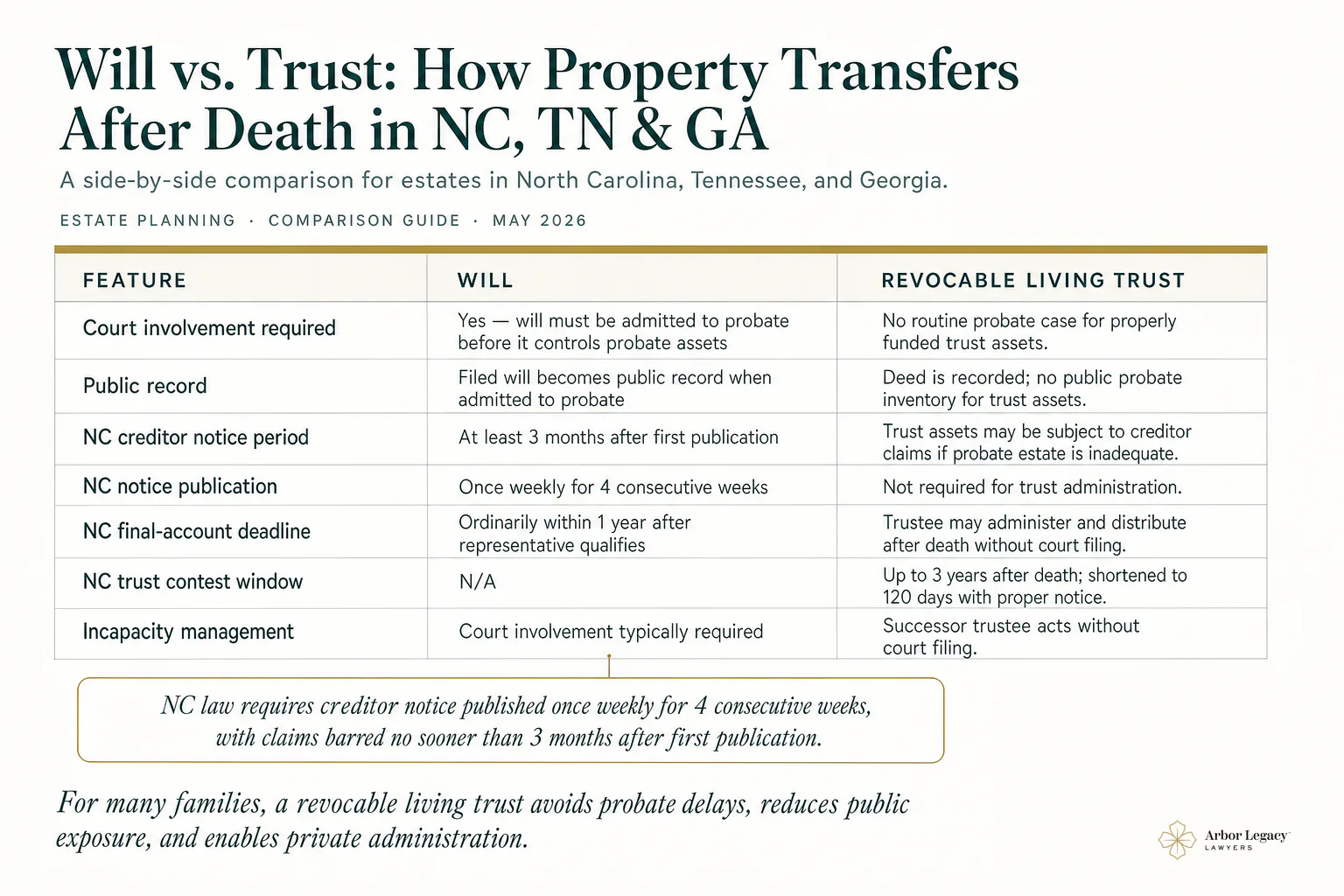
A house titled in one name alone passes through a court file first. In North Carolina, the personal representative publishes creditor notice weekly for four consecutive weeks, and the final account is not due until a year after qualifying (North Carolina General Assembly). Learning how to put property into a trust keeps your family out of court. Here is the process, plus the mortgage and tax questions that stall most families.
Why Putting Property in a Trust Protects Your Family More Than a Will Does
A will does not avoid probate, it tells the court how to distribute assets (choose between a will and a trust).
A Will Guarantees a Trip to Probate Court
A will has no legal effect until probated, then becomes public record (NC Courts). In Georgia, probate of a will in common form generally begins with Georgia Probate Court Standard Form 4 (GPCSF 4), while solemn-form probate or intestate administration use different standardized petitions (Georgia Probate Court Standard Forms).
A Trust Transfers Property Without a Probate Case
The deed makes the trustee owner of record, the successor trustee distributes property under the trust terms without probate. Creditors can still reach trust assets if the probate estate is inadequate (N.C.G.S. Chapter 36C).
Trusts Do More Than Avoid Probate
A trust also manages property during incapacity, a lifetime asset protection trust shields a child's inheritance.
What Type of Trust Is Right for Holding Your Property
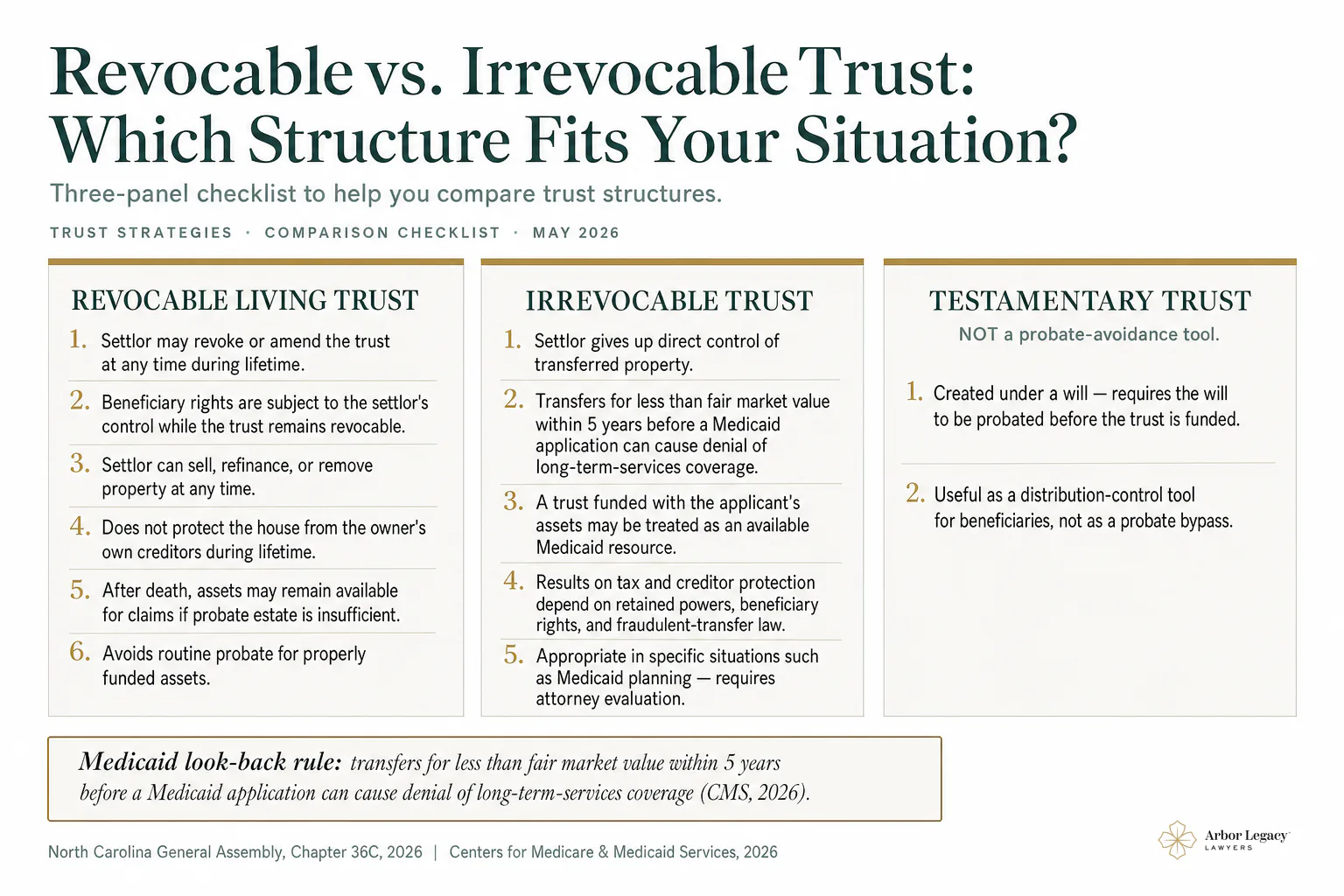
A revocable living trust suits most homeowners, the difference between the two drives the plan.
Revocable Living Trusts Keep You in Control
You stay trustee and can sell, refinance, or revoke anytime, terms fix at the settlor's death.
Irrevocable Trusts Trade Control for Protection
Property may sit outside your estate and beyond some creditors. The look-back is a Medicaid eligibility rule applied to certain transfers, not a feature of the trust structure itself. Medicaid penalizes below-market transfers within the 60-month look-back (42 U.S.C. § 1396p).
Special Situations Call for Different Structures
Disability benefits may require a special needs trust. A testamentary trust, created by will, does not avoid probate.
The Step by Step Legal Process for How to Put Property into a Trust
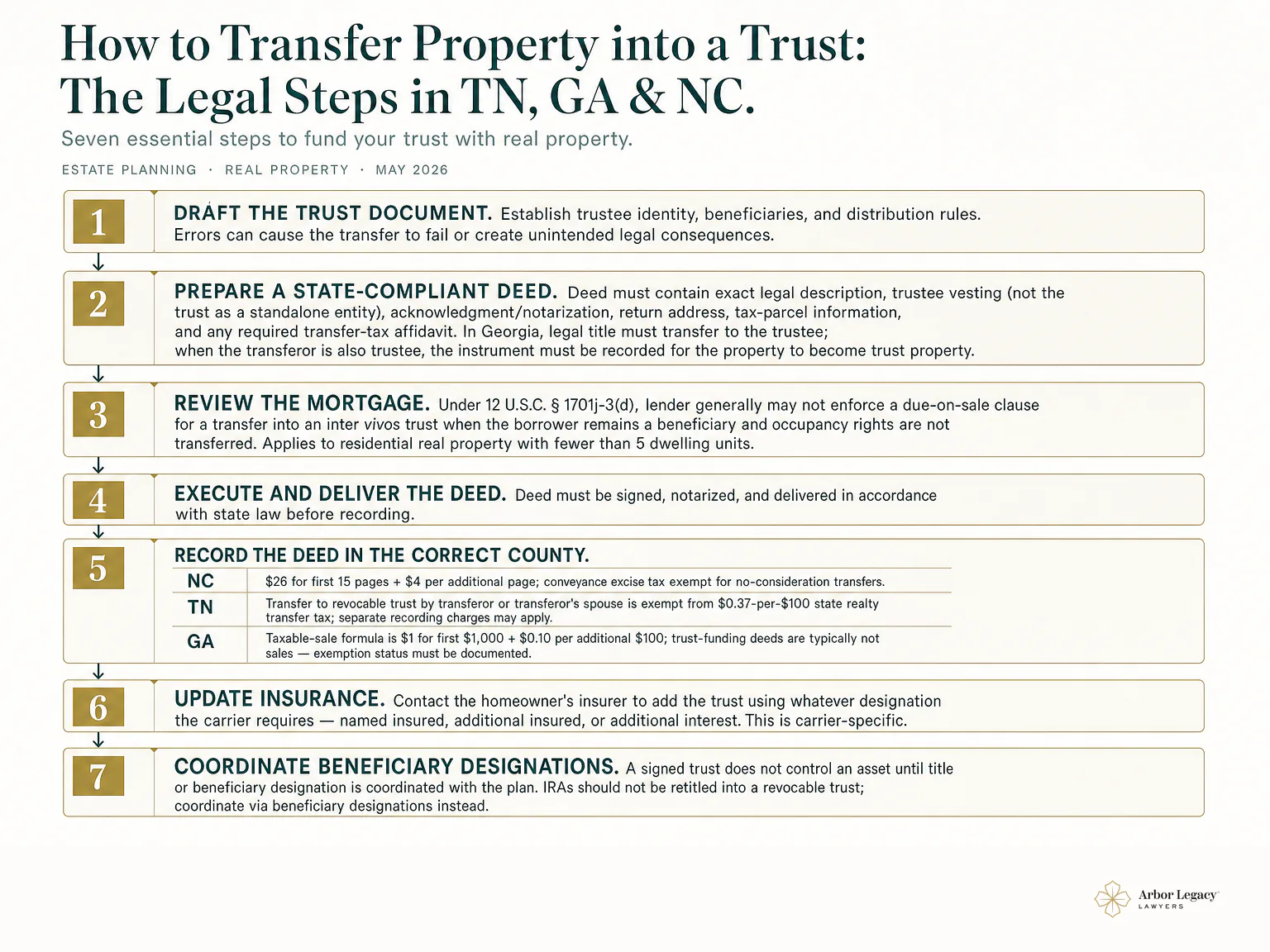
Funding a trust matters as much as signing one.
Step 1, Create the Trust Document
Name trustee, beneficiaries, and terms, fill-in-the-blank forms are where families end up with an expensive mess.
Step 2, Prepare and Record the Deed
Georgia law requires a valid transfer of legal title to the trustee, typically by deed, and recording the deed or an appropriate certificate of trust is strongly recommended to establish the trust's interest in the public record and protect against later adverse claims. Record the deed, naming the trustee in fiduciary capacity, with the register of deeds (TN, NC) or superior court clerk (GA). NC charges $26 for 15 pages, $4 each additional (N.C.G.S. 161-10). Georgia's excise tax on sales: $1 per first $1,000 plus $0.10 per additional $100 (Georgia Department of Revenue).
Step 3, Update Insurance and Notify the Servicer
Have the carrier endorse the policy, trust-held homes and homeowners insurance is where claims get denied. Notify the servicer with a certificate of trust.
Having a Mortgage Does Not Stop You From Putting Property into a Trust
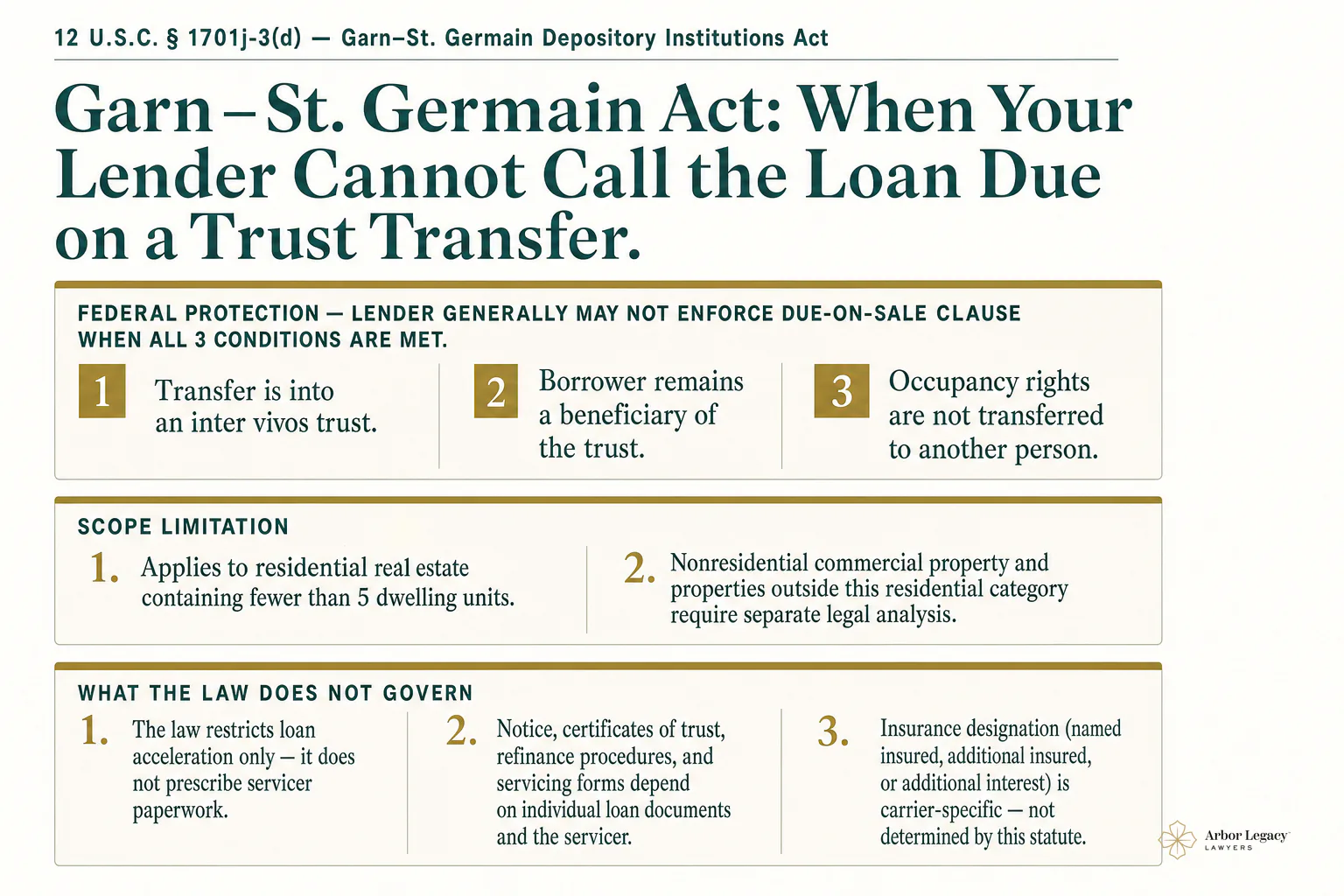
12 U.S.C. § 1701j-3(d) bars due-on-sale enforcement when a home enters an inter vivos trust, provided the loan is secured by residential real property containing fewer than five dwelling units, the borrower is and remains a beneficiary, and the transfer does not relate to a transfer of occupancy rights (U.S. Code).
What to Send Your Lender
Send a certificate of trust, keep written records.
Where the Protection Stops
Commercial, larger multifamily, investment, and LLC transfers need lender review first.
What Happens to Property Taxes and Homestead Exemptions When You Transfer
Trusts and taxes deserve their own conversation, homestead rules differ by state and county.
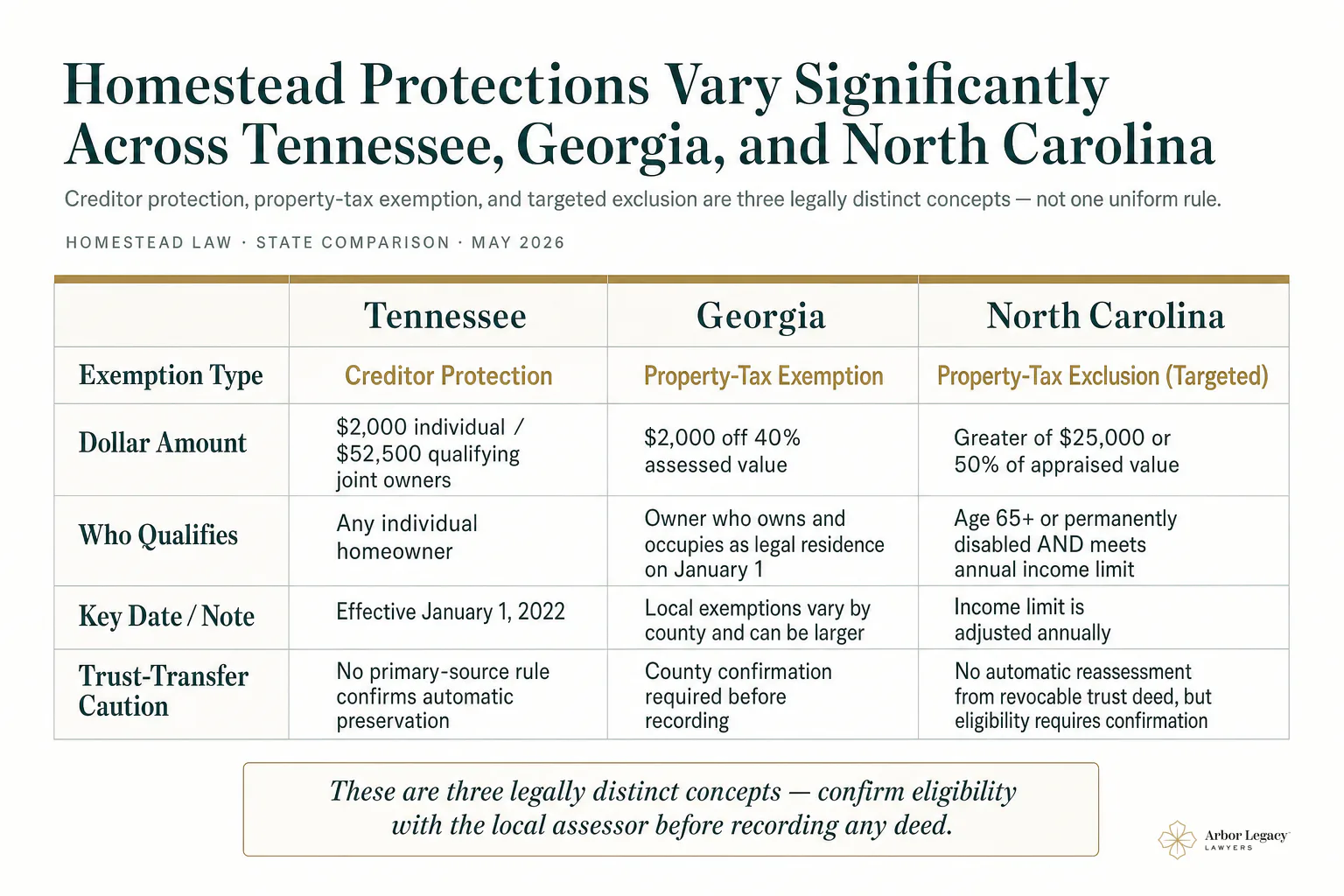
Tennessee, Georgia, and North Carolina Handle This Differently
Tennessee's $35,000 individual and $52,500 qualifying joint homestead, effective January 1, 2022, is creditor protection, a different legal concept than property-tax homestead treatment, and does not bar public taxes (Tennessee General Assembly). Georgia exempts $2,000 off 40% assessed value for owners occupying as legal residence on January 1, with larger exemptions at 65+ with qualifying income (Georgia Department of Revenue). North Carolina excludes the greater of $25,000 or 50% of appraised value for income-qualified owners 65 or permanently disabled (N.C.G.S. 105-277.1), plus a circuit breaker deferral (N.C.G.S. 105-277.1B).
Confirm Before You Record
North Carolina reappraises countywide at least every eight years, not per transaction (N.C.G.S. 105-286, NCDOR), so recording into a revocable trust triggers no new appraisal. Verify eligibility with your county office.
What Other Property Can Go into a Trust Besides Your Home
Cabins, rentals, and land follow the same deed process (how to put your assets in a trust).
Real Property in More Than One County or State
Convey each parcel under local law, or families face an ancillary proceeding, joint tenancy avoids probate but forfeits control.
Accounts and Business Interests
Retitle bank and brokerage accounts, LLC interests need operating-agreement review. Retirement accounts pass by beneficiary designations, an IRA is typically a trust or custodial account established under Internal Revenue Code § 408 and passes to named beneficiaries under the account agreement rather than through the probate estate (IRS Publication 590-A).
Frequently Asked Questions
What are the disadvantages of putting your house in a trust?
Setup costs, upkeep, and no creditor protection.
How much does it cost to put a property into a trust?
No national average, confirm quotes cover deeds, recording, and transfer tax.
Is it a good idea to put real estate into a trust?
Usually yes, if the deed is recorded correctly.
Is it better to inherit a house or put it in a trust?
Not competing, inherited property generally gets stepped-up basis at death (IRS Publication 559).
Do I still need a will if my house is in a trust?
Yes, a pour-over will catches omissions and names guardians.
Your Family Deserves a Plan That Works When It Is Needed
Every solely owned parcel without a nonprobate transfer becomes a court file. Our Life & Legacy Planning reviews your property and goals with transparent pricing, so your plan works when your family needs it. Get started with Arbor Legacy Lawyers.
This article is a service of Arbor Legacy Lawyers P.C. and is provided for educational and informational purposes only. It does not constitute legal advice and does not create an attorney-client relationship. Estate planning laws vary by state; consult a qualified attorney about your specific situation.
Matthew "Web" W. Raulston Father & Estate Planning Attorney, Arbor Legacy Lawyers P.C. Arbor Legacy Lawyers, P.C.