
Key Takeaways
- An advance directive is a legal document that records your health care wishes and names someone to make medical decisions when you cannot speak for yourself.
- Without one, hospitals default to maximum life-sustaining treatment and your state chooses who makes your health care decisions.
- Every adult 18 and older needs an advance directive, not just older adults or the seriously ill.
- Tennessee, Georgia, and North Carolina each have specific witness and notary rules, and an improperly signed form can be rejected.
- An advance directive is one piece of a complete plan that keeps your family out of court and out of conflict.
Get insights like this in your inbox
*Written by Matthew "Web" W. Raulston, Father & Estate Planning Attorney, Arbor Legacy Lawyers P.C.* For over 15 years, Web Raulston has been a trusted advisor to individuals, families, and businesses throughout Georgia and Tennessee. A member of the State Bar of Georgia and a father himself, Web focuses on estate planning, business law, and real estate, helping clients protect what matters most through Arbor Legacy's life and legacy planning model.
Picture a family standing in a Hamilton County hospital hallway, unable to honor a father's wishes about a ventilator because he never wrote anything down. When there is no plan, families are left guessing instead of grieving — and that uncertainty plays out constantly across Chattanooga, Franklin, Alpharetta, Trenton, GA, and Blue Ridge, GA because most people never answer a basic question, what is advance directive planning, and why does it matter? Only 22% of Americans have documented their end-of-life care wishes, according to a NORC at the University of Chicago survey, meaning 78% leave those decisions to strangers, courts, or family conflict. This article explains what an advance directive is, which documents it includes, how it works in Tennessee, Georgia, and North Carolina, and what your family risks without one.
What Is Advance Directive in Plain English
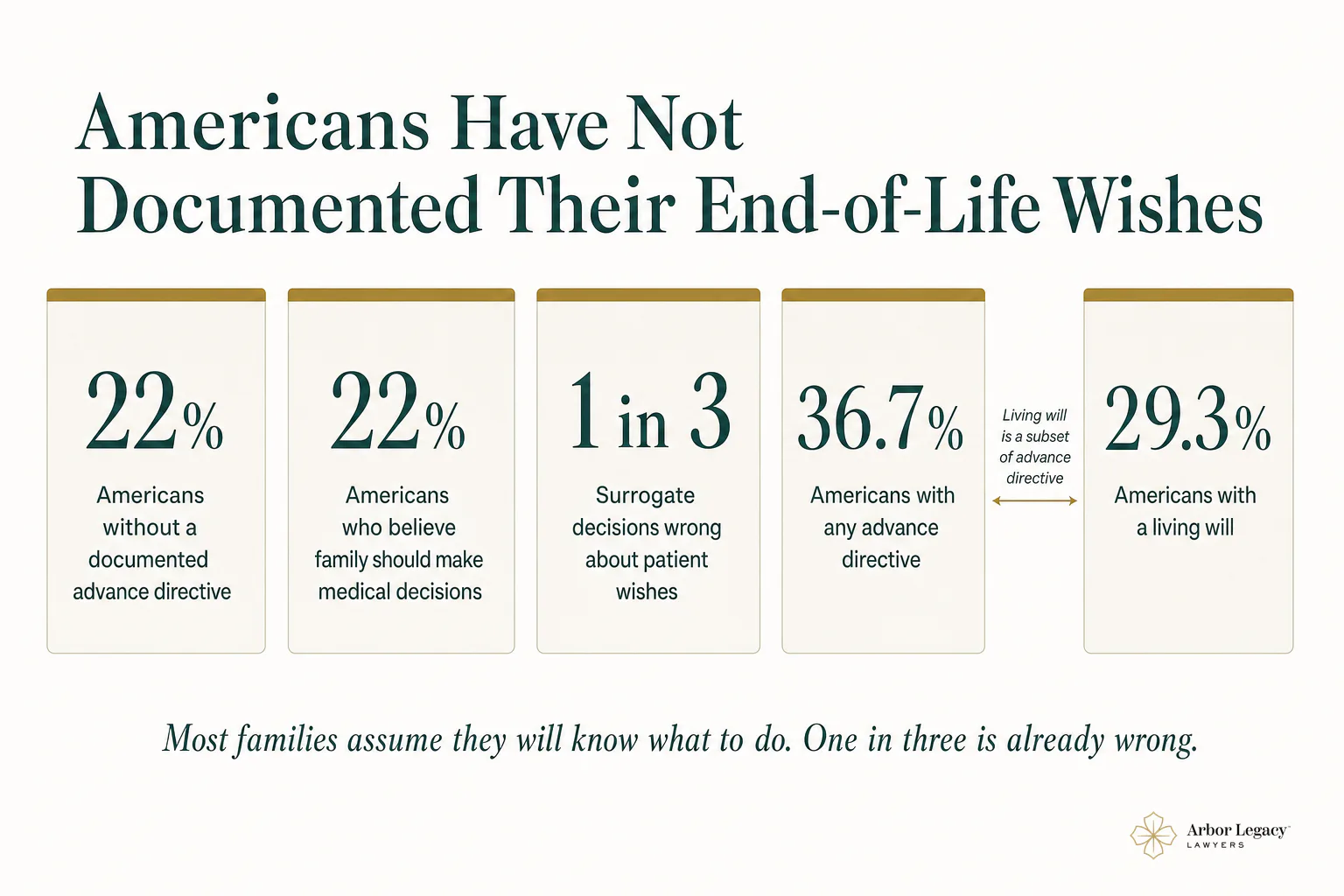 22% of Americans Have Not Documented Their End-of-Life Wishes — Source: NORC/University of Chicago (VITAS), 2023; National Institute on Aging, 2021; PubMed, 2017
The Core Definition Without the Legal Jargon
An advance directive is a legal document, or set of documents, that records your health care wishes and designates someone to make medical decisions for you when you can no longer make your own health care decisions for yourself. It is also a deeply personal expression of your values — what quality of life means to you, what matters most, and what kind of care reflects who you are. Many people assume their spouse or adult children automatically hold this authority, but often they do not without proper documentation. According to the National Institute on Aging, surrogates guess wrong about a patient's wishes in roughly one out of three cases. In other words, even people who know you well will get your treatment preferences wrong about a third of the time — and a systematic review in Archives of Internal Medicine confirmed this, finding surrogates predict treatment preferences with about 68% accuracy, and neither prior conversations nor being formally designated improved that much. Health care professionals and advanced directives specialists emphasize this gap as a core reason to document your wishes in writing.
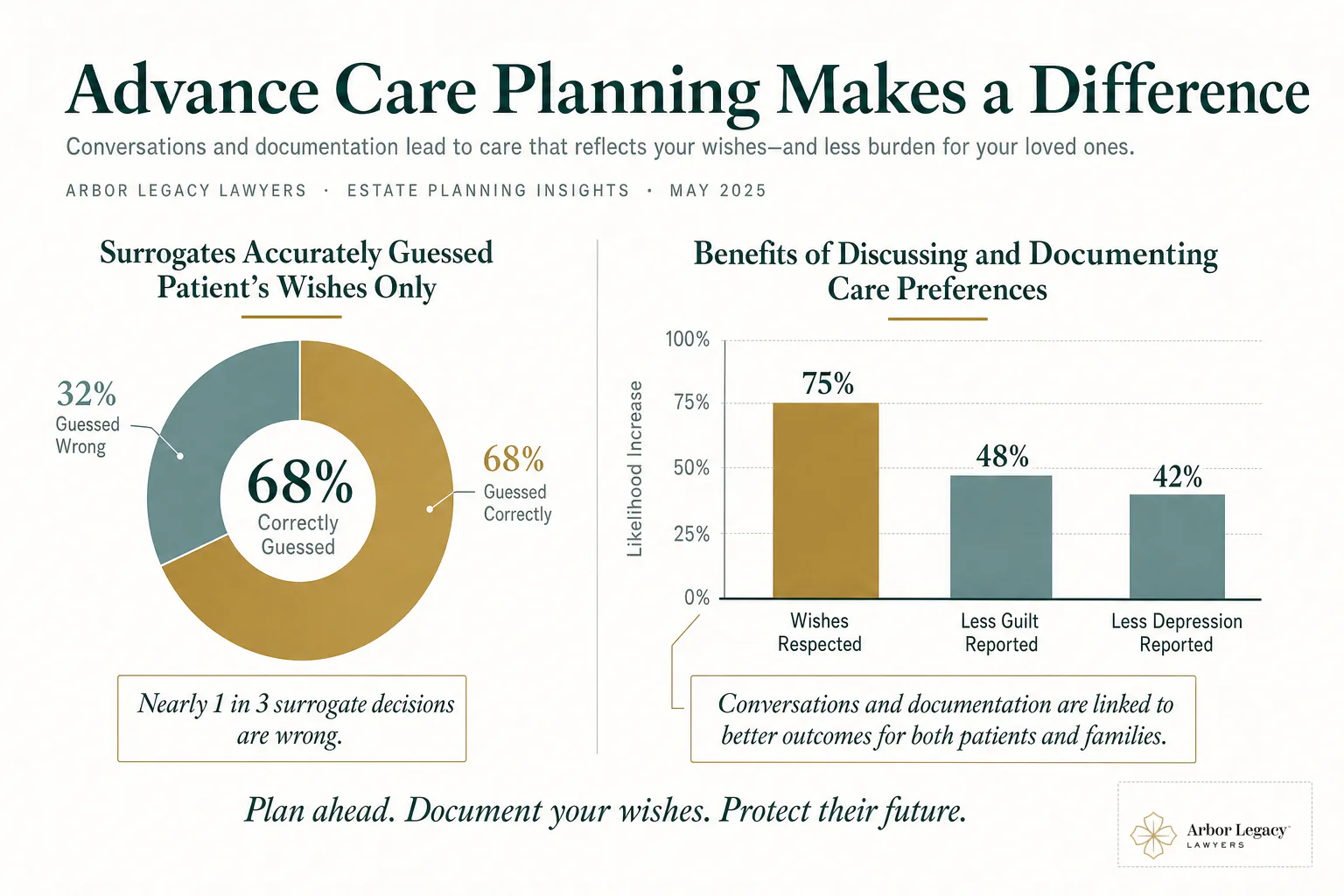 Advance Care Planning Statistics (NIA) – Nearly 1 in 3 surrogate decision-makers guessed wrong about a loved one’s end-of-life treatment preferences. Research also shows having an — Source: National Institute on Aging, 2021 ([www.nia.nih.gov](https://www.nia.nih.gov/health/advance-care-planning/advance-care-planning-advance-directives-health-care#::text=During%20an%20
Why "Advance" Is the Key Word
"Advance" means you create it before a crisis, not during one. Hospitals cannot accept directives signed in the ICU waiting room, and completing your directive while healthy produces better, more personalized instructions. The NIA's framework shows that people who plan ahead are more likely to receive medical care consistent with their wishes, and their loved ones feel less burden and guilt. Planning ahead also protects families outside the traditional mold, which is why estate planning for unmarried couples hinges on naming the right person before a crisis strikes.
How Tennessee, Georgia, and North Carolina Define Advance Directives
Each state uses slightly different terminology. Tennessee's official form is the Advance Directive for Health Care, also called an Advance Care Plan. Georgia's Advance Directive for Health Care combines a living will and health care proxy into one document. North Carolina uses separate forms, a Health Care Power of Attorney and an Advance Directive for a Natural Death, meaning the advance health care directive function is split across two distinct documents. These states generally recognize each other's directives when properly executed, but using the correct state-specific advance directive forms avoids confusion at the bedside.
The Three Documents Most Advance Directives Include
The Living Will Your Treatment Instructions in Writing
A living will records your specific wishes about life-sustaining treatment such as cardiopulmonary resuscitation, mechanical ventilation, artificial nutrition and hydration, palliative care, and tissue donation. It does not mean "do not treat me." It means your care reflects your values, not hospital defaults. About 36.7% of adults have completed some type of advance directive, but only about 29.3% have a living will, according to a systematic review published in Health Affairs pooling data through 2016.
The Durable Power of Attorney for Health Care
A durable power of attorney for health care, also called a health care proxy or medical power of attorney, names a person to make real-time medical decisions on your behalf. This differs from a financial power of attorney, which handles money. "Durable" means the document stays valid even after you lose mental capacity, unlike a standard power that terminates at incapacity. Choose a health care agent who is available, willing to advocate, and aligned with your values. For someone with early-stage dementia, this document is especially critical.
Do Not Resuscitate Orders and POLST Forms Related but Different
A DNR order and a POLST form are physician-issued medical orders, not advance directives you create alone. A DNR must be signed by a physician and travels with you through health care facilities, including any nursing home or hospital where you receive care. A POLST is used mainly for people with serious illness or advanced age. Nearly all states have adopted POLST programs, though the form name and legal framework differ by state. If you want either, work with both your health care provider and your estate planning attorney.
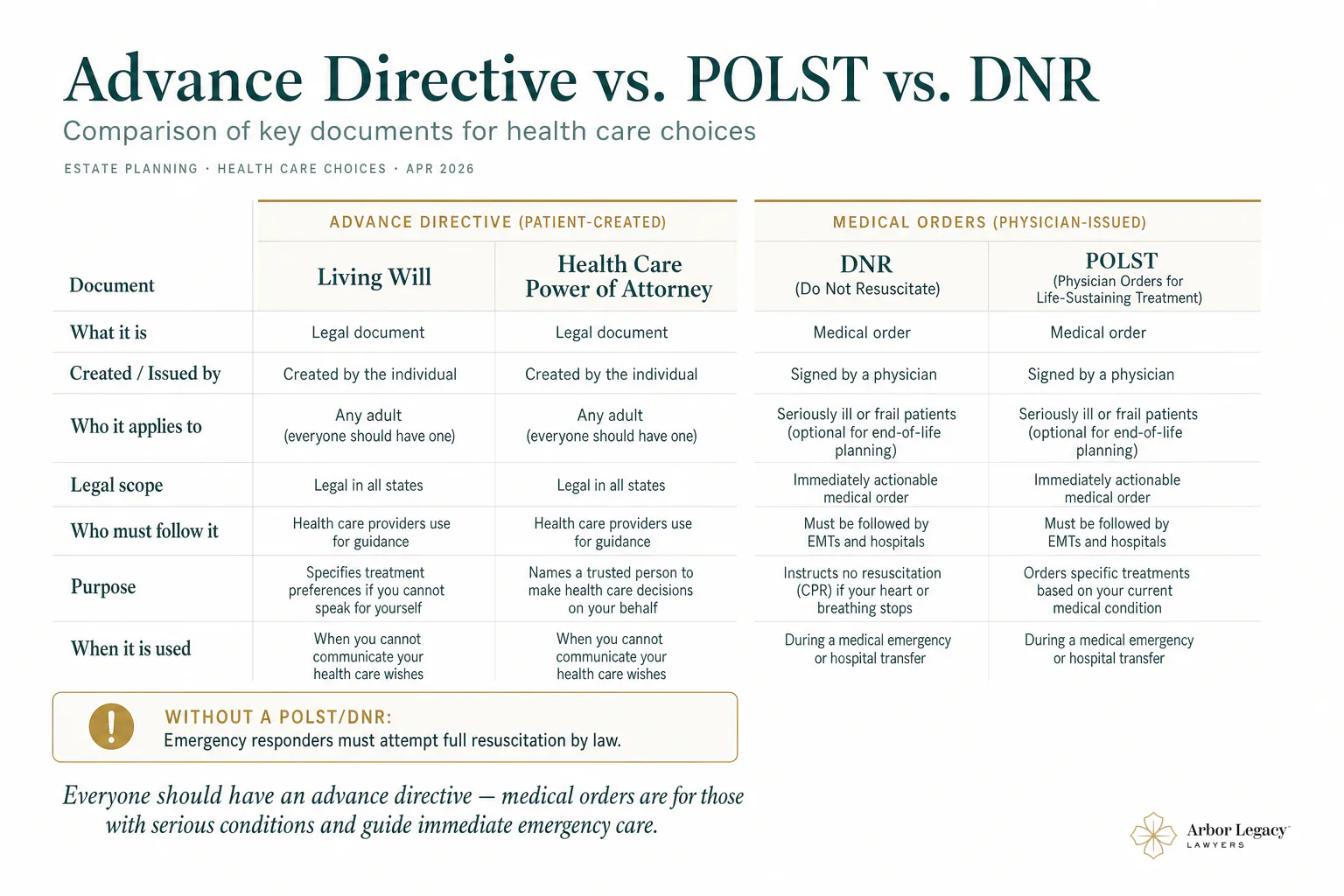 Advance Directive vs. POLST vs. DNR – Comparison of key documents for health care choices: Living Will and Health Care Power of Attorney are advance directive documents created by — Source: National Hospice and Palliative Care Organization (CaringInfo), 2024 ([www.caringinfo.org](#::tex
What Happens to Your Family Without an Advance Directive
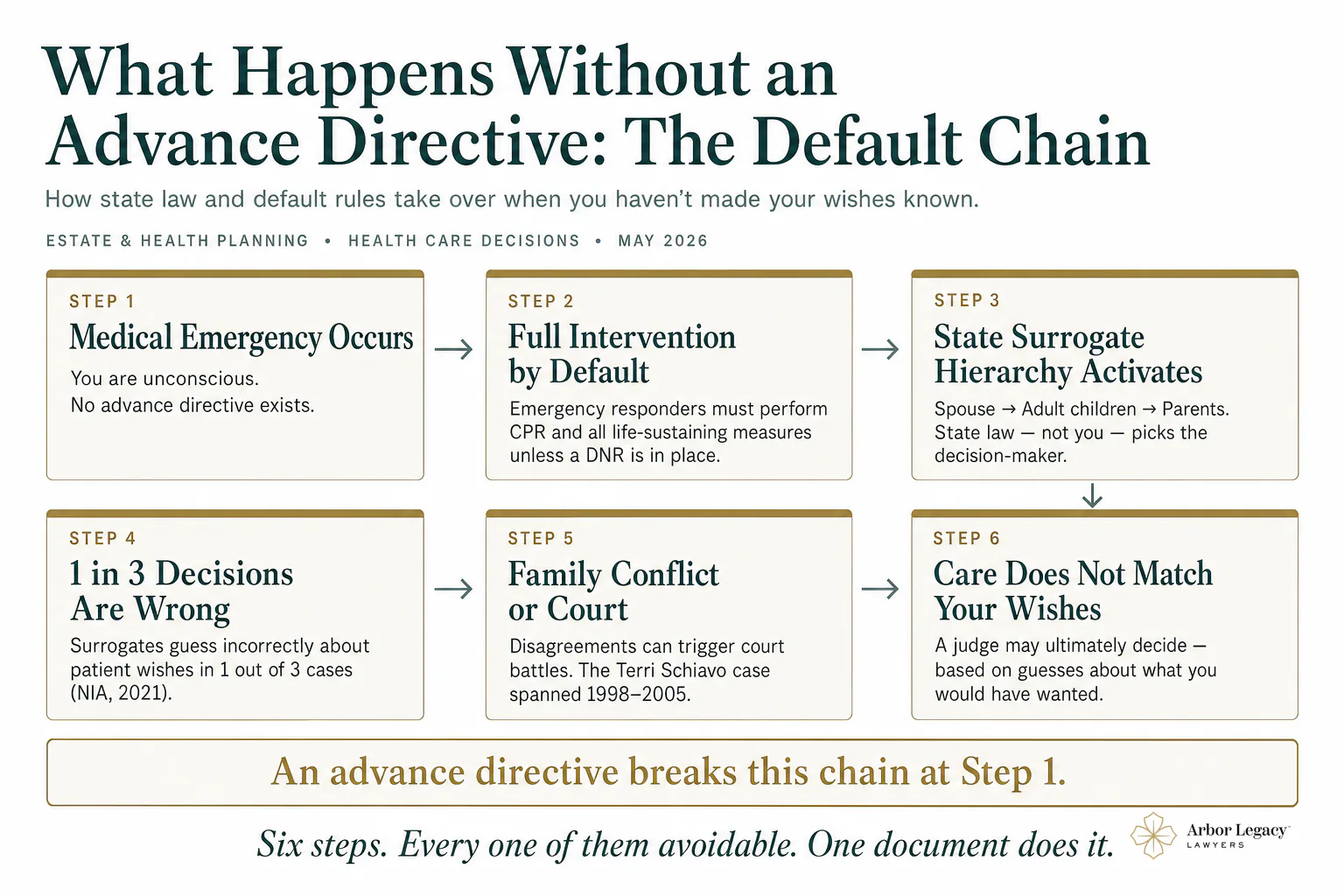 What Happens Without an Advance Directive: The Default Chain — Source: CaringInfo (NHPCO), 2026; National Institute on Aging, 2021
Hospitals Default to Maximum Intervention
Without a valid DNR or other medical order limiting treatment, emergency responders will generally attempt CPR and other life-sustaining measures when a patient is unresponsive, a standard reflected in guidance like the Illinois Department of Public Health's. About 13%, roughly one in eight, decedents received end-of-life care that family reported was inconsistent with the patient's wishes, according to a 2017 study in the Journal of Palliative Medicine. That study also found such inconsistency was linked to worse ratings of overall care, pain management, and clinician communication. Your family cannot override the default without legal documentation, and even a sustaining treatment decision made by a surrogate may not reflect what you would have wanted.
Your Loved Ones May End Up in Probate Court
When family members disagree and no directive exists, courts can become involved. The Terri Schiavo case, which spanned court battles from 1998 through 2005, remains the most recognized example of a years-long legal fight caused by the absence of clear instructions. Guardianship or conservatorship proceedings are expensive, slow, and painful, exactly the court interference thoughtful planning is designed to avoid. Our look at whether your estate plan will work when your family needs it shows how missing pieces surface at the worst moment.
Family Members Can Be Left with Guilt Not Clarity
Even when no legal dispute arises, family members forced to make decisions alone often carry lasting guilt. The NIA's research confirms that documented plans reduce that emotional burden. For blended families, where a stepparent and biological children may pull in different directions, clear instructions matter even more, as our guide to building a stronger blended family through estate planning explains.
Who Needs an Advance Directive The Answer May Surprise You
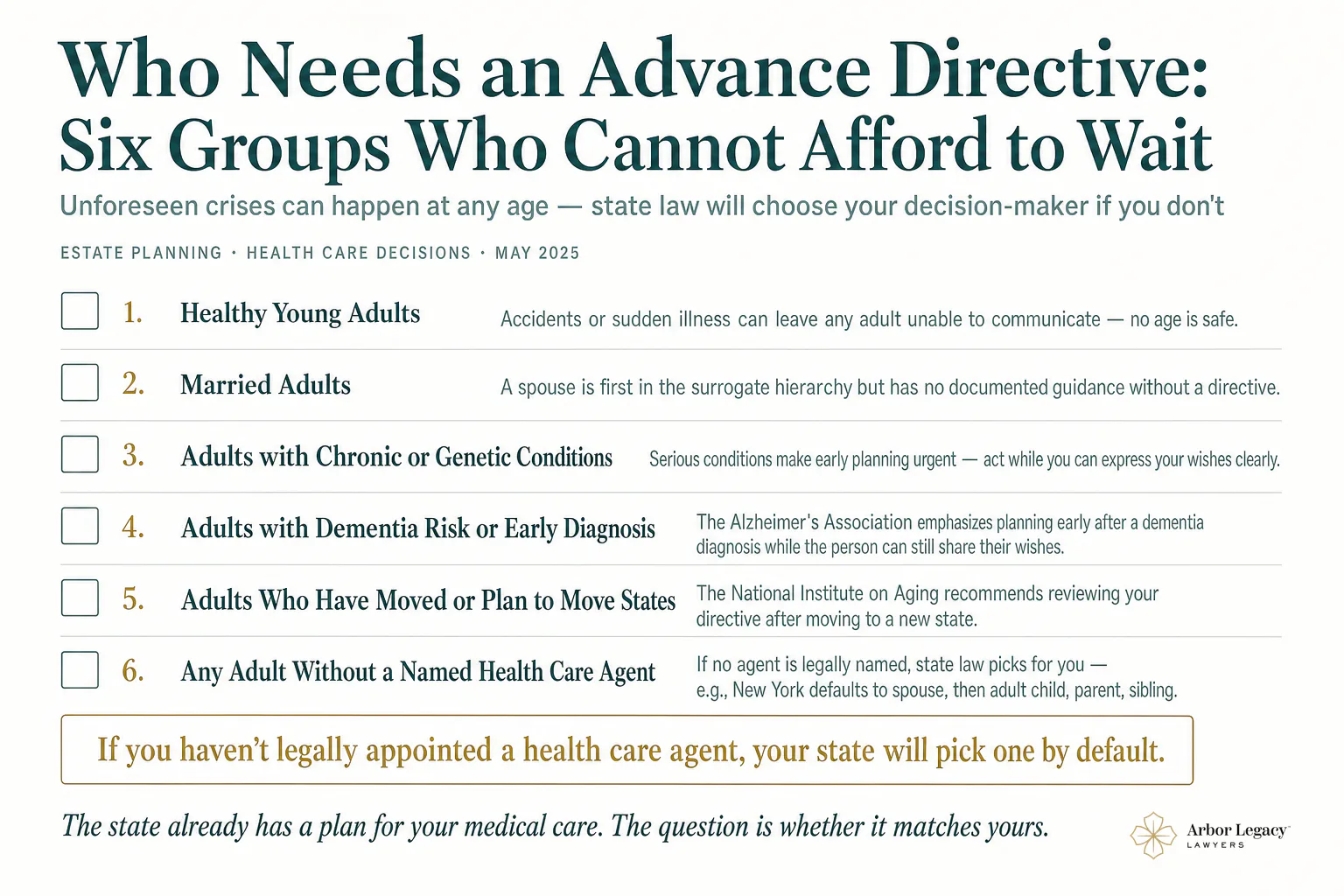 Who Needs an Advance Directive: Six Groups Who Cannot Afford to Wait — Source: National Institute on Aging, 2021; Alzheimer's Association; New York State Department of Health
Advance Directives Are Not Just for Older Adults
A common misconception treats health care advance directives as end-of-life documents for the elderly. The National Institute on Aging notes that unforeseen crises can happen at any age, and a healthy young adult can be left unable to communicate after an accident. Any adult 18 or older in Tennessee, Georgia, and North Carolina should have one, because as long as you are competent you have the right to make your own health care decisions. This is why families sending a teenager to college should not send their kids back to school without these documents, since a newly minted 18-year-old no longer grants parents automatic access to medical decisions. Parents of minor children especially need both a health care directive and a named guardian — and a complete Kids Protection Plan that ensures their children are raised by the people they choose, without court interference. This is the firm's signature approach: weaving Kids Protection Planning into every family's estate plan so that no crisis, medical or otherwise, leaves children without a clear, legally protected path forward.
Anyone Without a Designated Health Care Agent Is at Risk
If you never name a health care agent, your state's default surrogate hierarchy takes over, typically spouse first, then adult children, then parents, then siblings. In North Carolina, the Secretary of State and state law point to a spouse, then a majority of parents and adult children, then a majority of adult siblings, and finally a close person acting in good faith. That default may conflict with your own decisions about care, or the top person may be unavailable. Because surrogates guess wrong about a third of the time, relying on them raises the odds your medical treatment diverges from what you would have chosen.
People With Specific Medical Concerns Have Even More Urgency
Anyone with a chronic condition, a family history of dementia, or a recent serious diagnosis — including those advised by the American Cancer Society to document wishes early — should treat this as urgent. The Alzheimer's Association urges planning as early as possible in the course of dementia, while the person can still share their wishes. These documents can and should be updated as health changes. If you or a loved one is navigating aging, disability, or a serious diagnosis, our elder law planning and special needs planning services are designed to address exactly these situations. Our two-part series on 10 common estate planning mistakes your family cannot afford to make covers several that trip up families dealing with a new diagnosis.
How to Create a Legally Valid Advance Directive in Tennessee, Georgia, or North Carolina
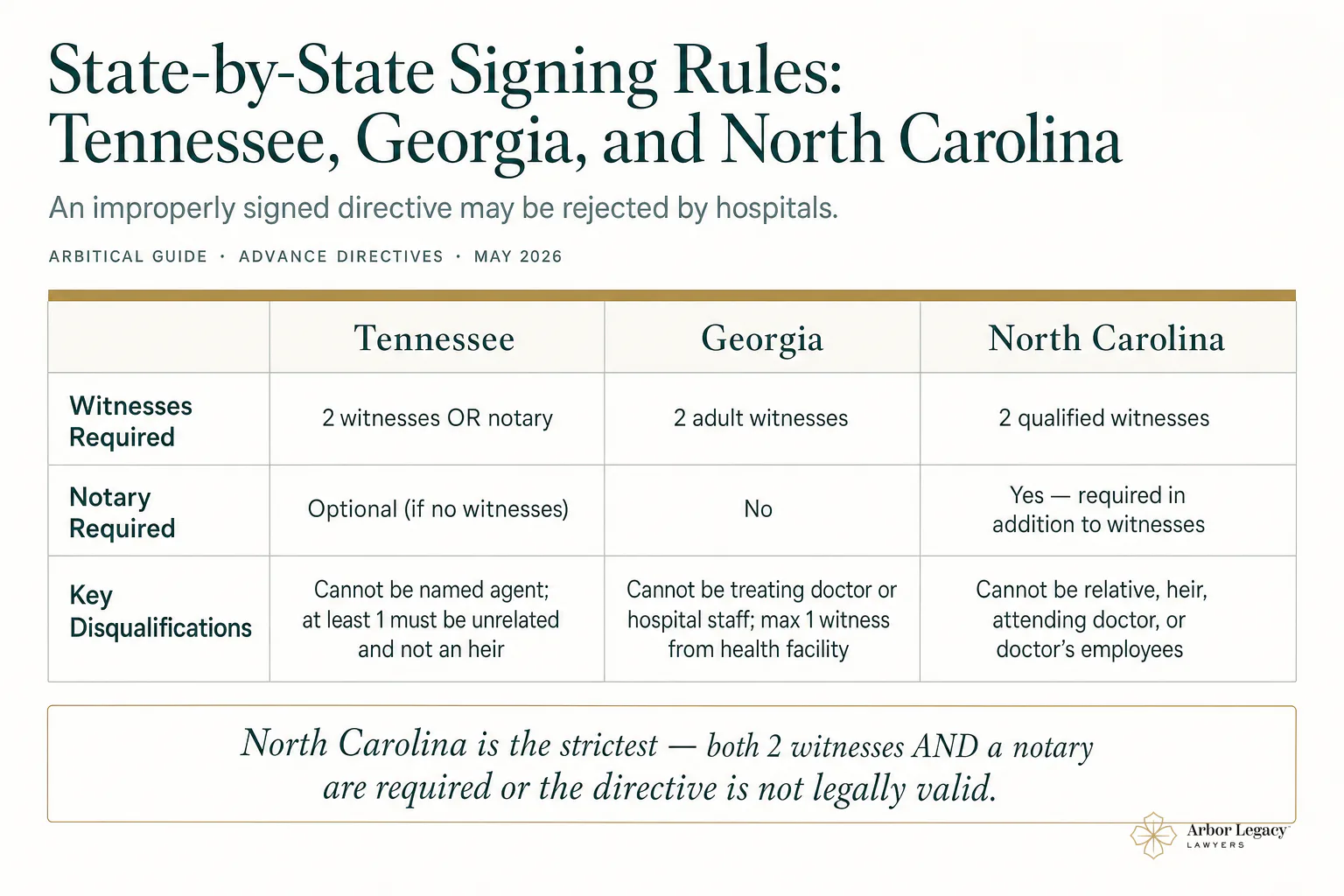 State-by-State Signing Rules: Tennessee, Georgia, and North Carolina — Source: WillMaker (Nolo), 2024
The Execution Requirements Each State Demands
Signing rules for advance directive forms vary by state, and errors can make a directive unenforceable. Tennessee requires either two competent adult witnesses or a notary, not both, and witnesses cannot be your named agent, with at least one unrelated by blood, marriage, or adoption and not entitled to any part of your estate. Georgia requires two adult witnesses not directly involved in your care, and no more than one may be a facility employee, per Georgia Code 31-32-5. North Carolina requires two qualified witnesses and a notary.
Where to Store Your Advance Directive So It Can Be Found
A directive locked in a home safe does no good in an emergency room. Give copies to your health care agent, your primary physician, and any health care facility where you receive regular care. North Carolina maintains a state registry for advance healthcare directives, and Tennessee lets residents record in the state's driver services emergency contact system that they have an Advance Directive. A wallet card indicating the document and its location helps first responders act fast.
When to Review and Update Your Directive
Treat your advance directive as a living document. When circumstances change, you may need to create a new advance directive to reflect your updated wishes. The National Institute on Aging suggests reviewing it at least annually and updating after any major life event, including marriage, divorce, the death of a named agent, moving to a new state, or a serious change in health. A good way to surface these updates is to talk them through, and our tips on how to talk about estate planning at your family reunion make those conversations less awkward.
How Advance Directives Fit Into a Complete Estate Plan
The Documents That Work Alongside an Advance Directive
An advance directive handles health care decisions while you are incapacitated but alive. A will handles asset distribution after death. A revocable living trust can manage both incapacity and death-related asset transfer. A financial durable power of attorney handles money during incapacity. Fewer than half of Americans have basic planning documents, with only about 38% holding a will, according to CivicScience data published in 2023. Each piece covers a gap the others cannot, and together these legal documents form the foundation of a complete estate plan.
How an Estate Planning Attorney Adds Value Over Free Forms
Free advance directive forms capture instructions but not context or conversation; for more information about which form applies in your state, an attorney can help you navigate the options. If you are still asking what is advance directive planning and whether it applies to you, the short answer is: it applies to everyone. An attorney guides you through decisions you may not know to ask about, such as what "quality of life" means to you specifically, what happens in a persistent vegetative state, and edge cases a form cannot anticipate. Attorney Matthew "Web" Raulston helps families build this planning as an ongoing relationship, not a document transaction, through the firm's Life & Legacy Planning model. This level of comprehensive, relationship-based planning has traditionally been available only to high-net-worth families, but Arbor Legacy Lawyers makes it accessible to everyone through transparent, no-surprise pricing. Organizations such as the American Bar Association also offer guidance on what to look for in estate planning services. "Web" Raulston helps families build this planning as an ongoing relationship, not a document transaction, through the firm's Life & Legacy Planning model.
Frequently Asked Questions
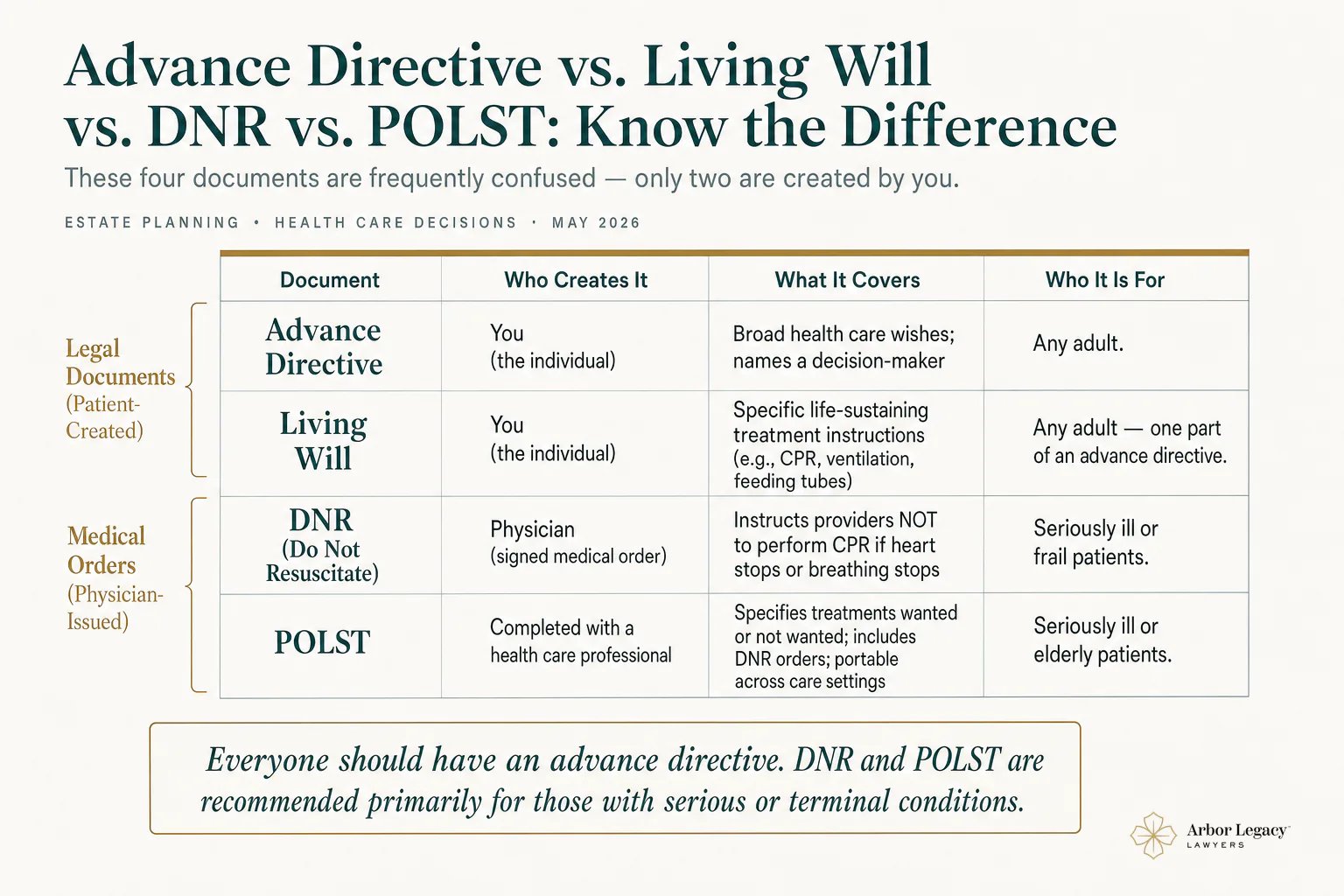 Advance Directive vs. Living Will vs. DNR vs. POLST: Know the Difference — Source: CaringInfo (National Hospice and Palliative Care Organization), 2024; National Institute on Aging, 2021
What is the meaning of advance directive?
A legal document that records your health care wishes and designates someone to make medical decisions on your behalf if you cannot.
How does an advance directive differ from a living will?
A living will is one type of advance directive recording specific treatment preferences, while "advance directive" is the broader term covering both the living will and the durable power of attorney for health care. Georgia combines both, North Carolina keeps them separate.
What are the most common three types of advance directives?
A living will, a durable power of attorney for health care, and a POLST, which are sometimes called other advance care planning forms. You create the first two yourself, the third requires a doctor, per CaringInfo.
What's the difference between a DNR and an advance directive?
A DNR is a physician-signed order not to perform cardiopulmonary resuscitation, an advance directive is a legal document you create while healthy. Your directive can instruct your agent to request a DNR, but a physician must issue it.
What happens if I don't have directives?
Hospitals default to maximum life-sustaining treatment, your state's surrogate hierarchy controls who decides, and disagreeing family members may end up in court.
Your Family Deserves a Plan Not a Crisis
Without an advance directive — and understanding what is advance directive planning in the first place — a medical emergency hands your most personal decisions to default legal rules and family conflict instead of your recorded wishes. Your health care agent cannot advocate for you if they were never named, and your health care providers cannot honor your values if they were never documented. Think of your advance directive not as a one-time form to file away, but as a living part of an ongoing plan — one that grows with your family, your health, and your life circumstances, and is best maintained through a trusted, relationship-based planning process.
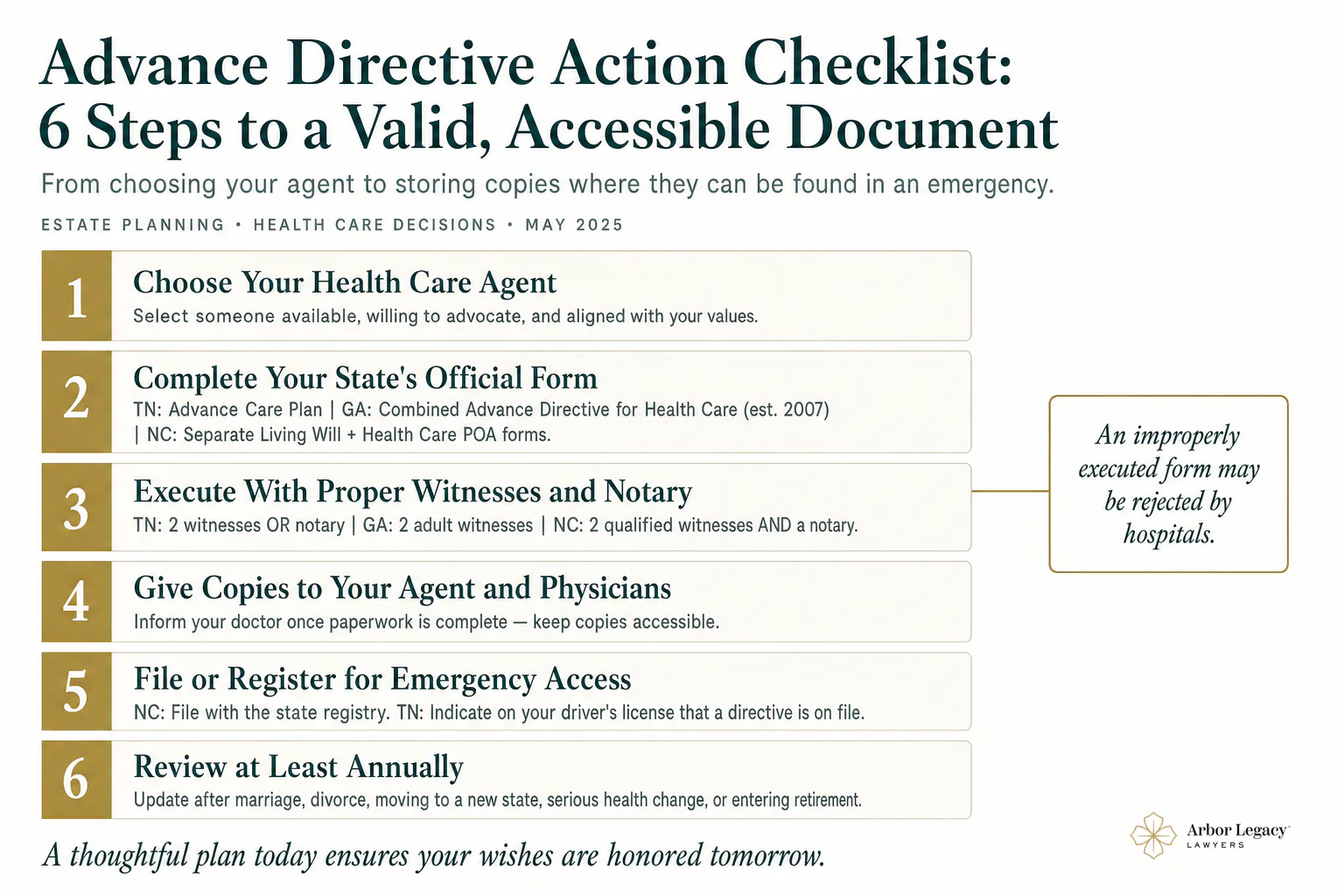 Advance Directive Action Checklist: 6 Steps to a Valid, Accessible Document — Source: TN Comptroller; NC Secretary of State; National Institute on Aging, 2021; WillMaker (Nolo), 2026
Arbor Legacy Lawyers helps families across Tennessee, Georgia, and North Carolina create advance directives that are state-specific, properly executed, and built into a complete estate plan designed to keep the people you love out of court and out of conflict. Other health care providers, financial advisors, and family members can all receive copies to ensure coordinated care.
The right time to create an advance directive is before you need it. Get started with Arbor Legacy Lawyers by scheduling a Life & Legacy Planning Session to put your wishes in writing and give your family the clarity they deserve.
This article is a service of Arbor Legacy Lawyers P.C. and is provided for educational and informational purposes only. It does not constitute legal advice and does not create an attorney-client relationship. Estate planning laws vary by state; consult a qualified attorney about your specific situation.
Matthew "Web" W. Raulston Father & Estate Planning Attorney, Arbor Legacy Lawyers P.C. Arbor Legacy Lawyers, P.C.