
Key Takeaways
- Probate is required when a deceased person owned assets titled solely in their name above the state small-estate threshold with no named beneficiary or co-owner.
- A will does not avoid probate. It is the document the probate court follows, not a way around it.
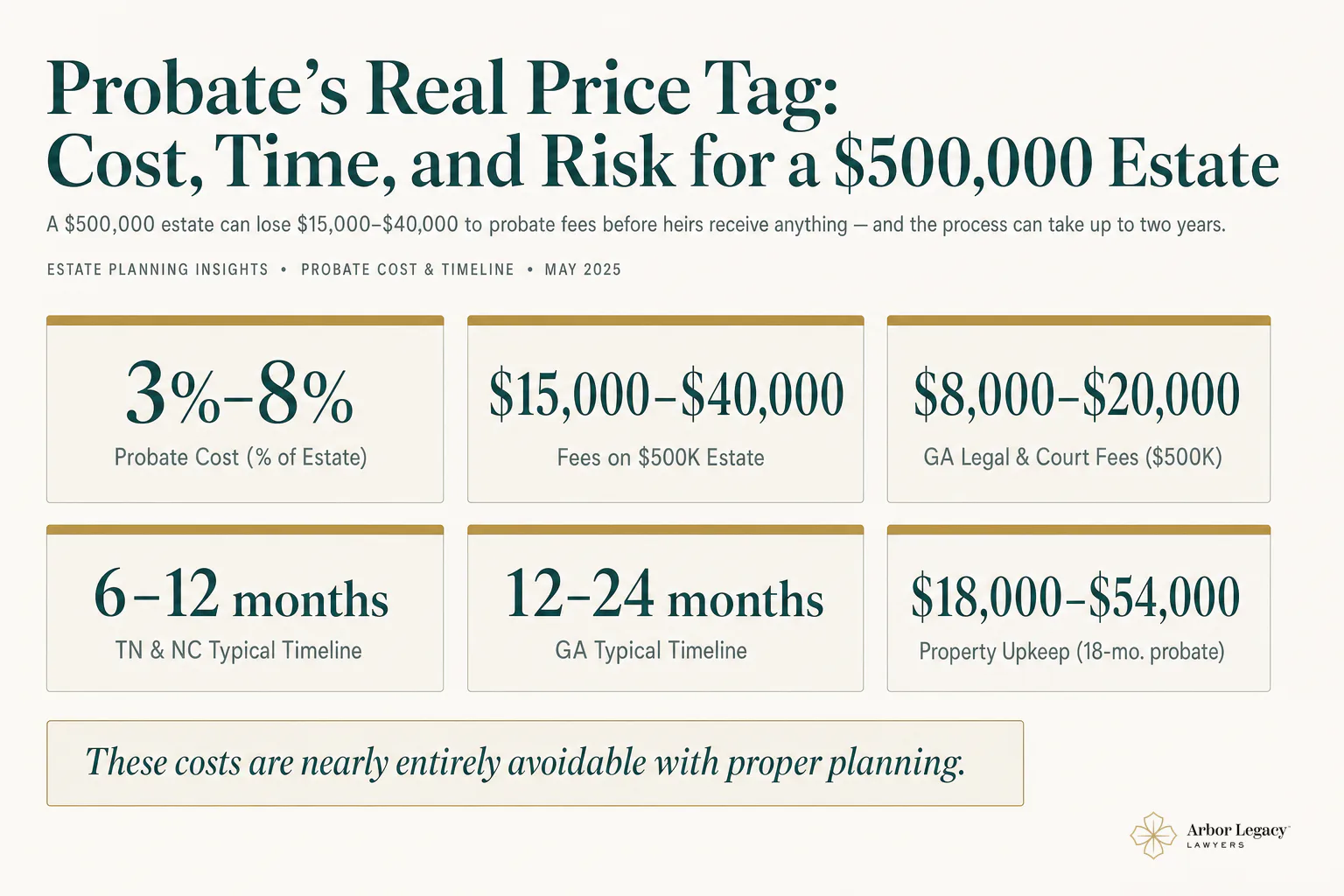
- Probate costs typically run 3% to 8% of the gross estate, meaning $15,000 to $40,000 on a $500,000 estate.
- A properly funded revocable living trust keeps virtually all assets out of probate court and stays entirely private.
- For parents, Kids Protection Planning names guardians so a court never decides who raises your children.
*Written by Kacie Gamble Tym, Mother & Estate Planning Attorney, Arbor Legacy Lawyers P.C.* Admitted to the Tennessee Bar in 2010, Kacie brings experience across estate planning, real estate, and title matters to individuals and families. A mother of three herself, she blends legal and real-life insight to make every closing smooth and every estate plan secure, helping clients protect what matters most through Arbor Legacy's life and legacy planning model.
A family in Hixson recently learned that before they could sell their late father's home near Hamilton County, a judge had to sign off. The house sat empty for eleven months while property taxes and insurance piled up, and legal fees ate into the inheritance he had worked forty years to build. That outcome is avoidable — but only with a plan in place before it is needed. That court process is probate, and for most families across Tennessee, Georgia, and North Carolina, it is the default outcome when no one planned around it. So when is probate required? Generally, whenever someone dies owning assets titled in their name alone with no automatic transfer path attached.
This article explains what triggers probate in these three states, which assets skip the process, and what your family can do now.
What Probate Actually Is and Why Courts Get Involved
Probate is the court-supervised legal process for transferring a deceased person's assets, sometimes called deceased person assets, to the right people when no automatic transfer mechanism is in place.
The Core Job Probate Does
When someone dies, somebody needs legal authority to collect their property, pay their debts, and distribute what remains from the decedent estate. Probate court grants that authority by appointing a personal representative, called an executor when there is a will and an administrator when there is not. Without that court order, no one holds legal ownership of decedent property titled in their name alone. If an asset sits in a deceased person's name with no beneficiary designation, probate is almost certainly required to move it. Frozen accounts, court delays, and grief often arrive together, which is what actually happens in the probate process for many families.
What the Probate Process Looks Like in Practice
The process follows a set sequence, filing a petition, validating the decedent will or establishing intestacy, inventorying estate assets, notifying creditors, paying valid debts and estate taxes, then distributing what remains. Tennessee law requires creditors to file claims within twelve months of death or four months after notice, whichever is earlier, creating a practical minimum probate duration of about four months even in the simplest estate (SwiftProbate). In North Carolina, executors typically complete key tasks in the first 60 to 90 days, pay debts and file tax returns within nine months, and file annual accountings while the estate stays open (Carolina Family Estate Planning). For more, see what probate is and how to avoid it, part 1.
What a Probate Court Can and Cannot Do
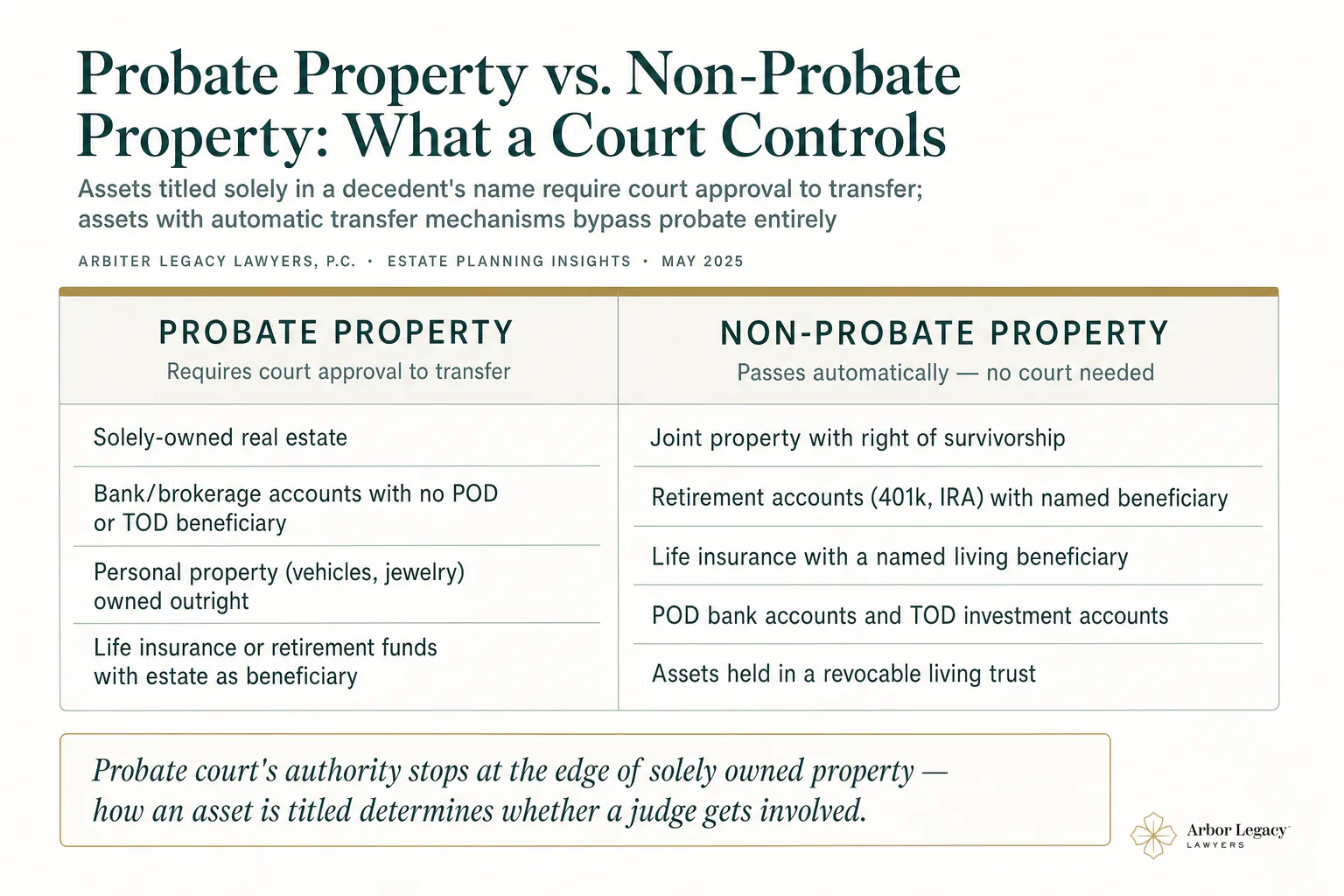
Probate court only controls probate property, meaning assets owned solely by the deceased person at death. Properly structured jointly held property, accounts with a named beneficiary, and assets held in trust are generally not subject to probate, though the court can become involved when those mechanisms fail or direct assets back to the estate (SmartAsset). Courts can still step in if someone disputes a beneficiary designation, but in ordinary administration those assets never pass through the court. This is why how each asset is titled matters more than most families realize.
When Is Probate Required by Law in Tennessee, Georgia, and North Carolina
Probate is generally required when a person dies owning assets titled solely in their name that exceed the state's small-estate threshold and carry no automatic transfer mechanism.
The Title Test That Determines Probate Property
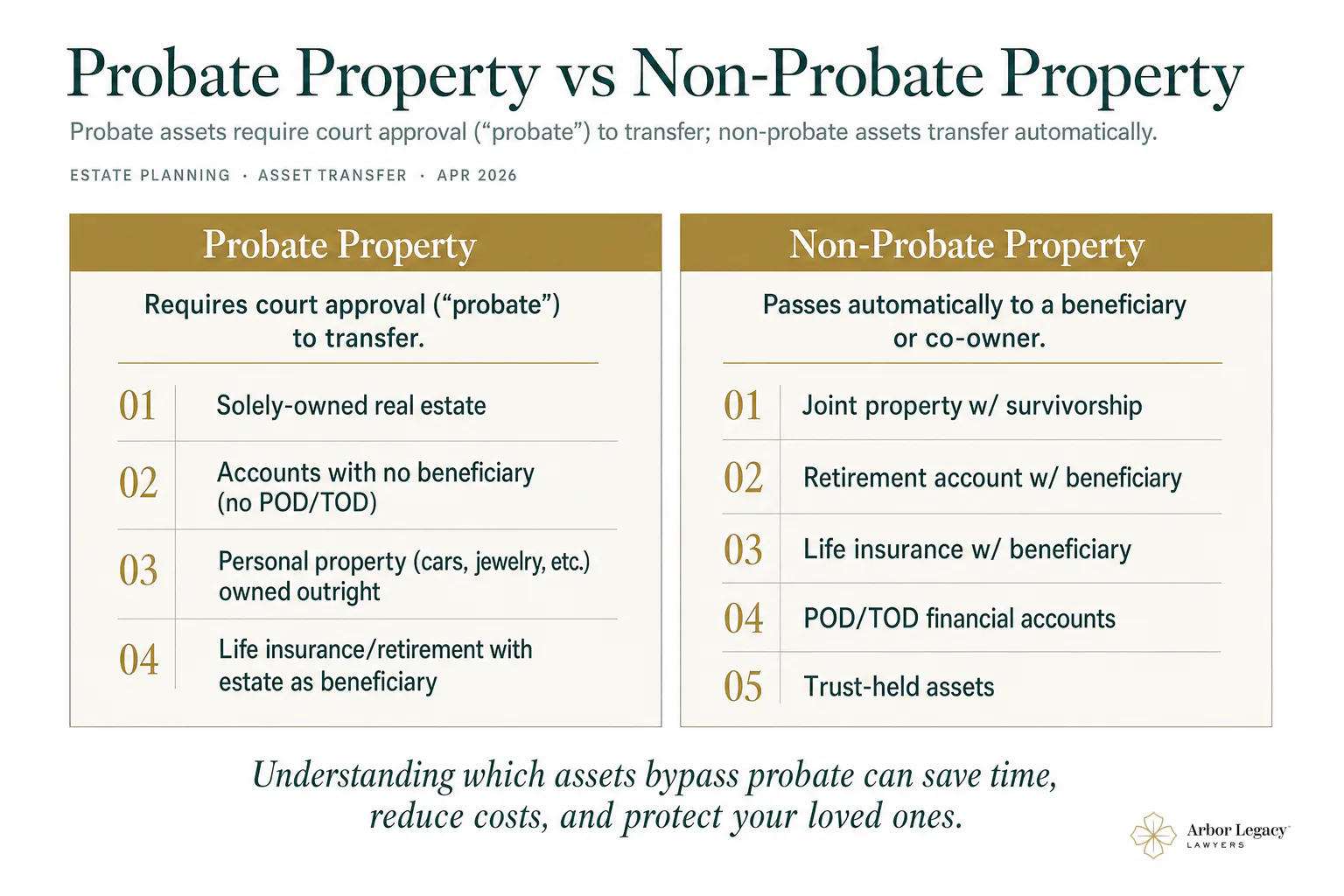
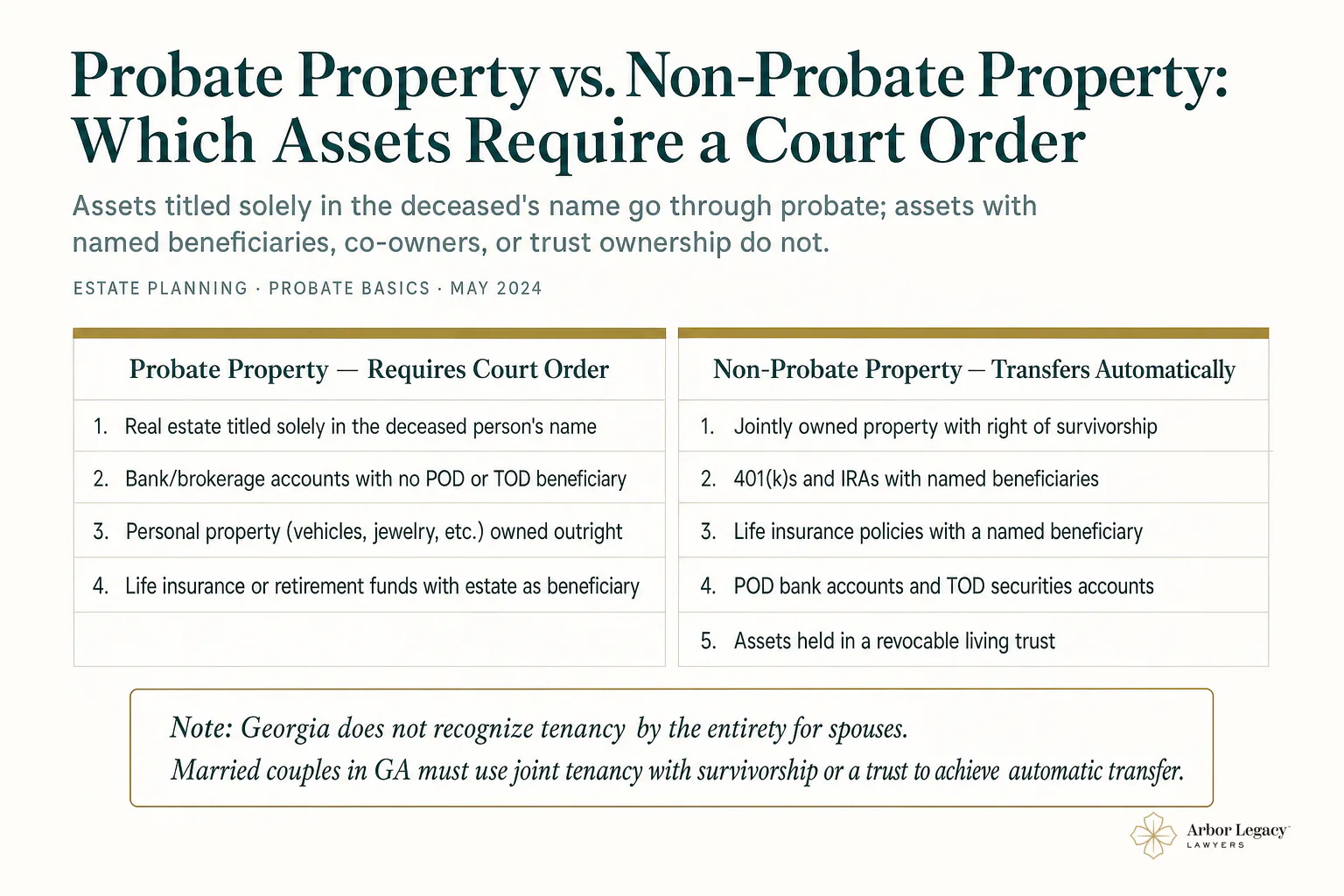
The clearest trigger is title. Real estate held solely in the deceased person's name, bank accounts with no payable-on-death designation, and investment accounts with no transfer-on-death registration all require court involvement to change ownership (SmartAsset). Contrast that with assets that transfer automatically, joint tenancy property passes to the surviving owner by operation of law, and retirement accounts and life insurance pay directly to named beneficiaries. The title in the decedent name, not the will, usually determines whether probate is required.
When a Will Does Not Prevent Probate
Many families believe a will avoids probate. It does not. A will is submitted to the probate court and must be validated before it has any legal effect on solely owned property — in legal terms, it is the court's instruction manual, not a bypass (Jackman Law Firm). It is the instruction manual the court follows, not a bypass. If your loved one owned real property in their name alone, that real estate goes through probate regardless of what the will says. The estate of Anne Heche, who died in 2022 and whose family is still paying for it, shows how much a missing plan can cost.
When There Is No Will at All
Dying intestate, without a will, still requires a probate proceeding for solely owned assets. The difference is the court distributes property under the state's default inheritance rules rather than the deceased person's wishes. In all three states, intestate succession laws prioritize the surviving spouse and lineal descendants — the legal heirs — before parents, siblings, and more distant relatives (Tennessee Code § 31-2-104, Pierce Law Group). Dying without a will just removes your voice from the outcome, which is where family conflict often begins.
Which Assets Pass Outside of Probate Automatically
Non-probate assets are set up to transfer at death by contract or survivorship, so no court touches them.
Accounts and Policies With Named Beneficiaries
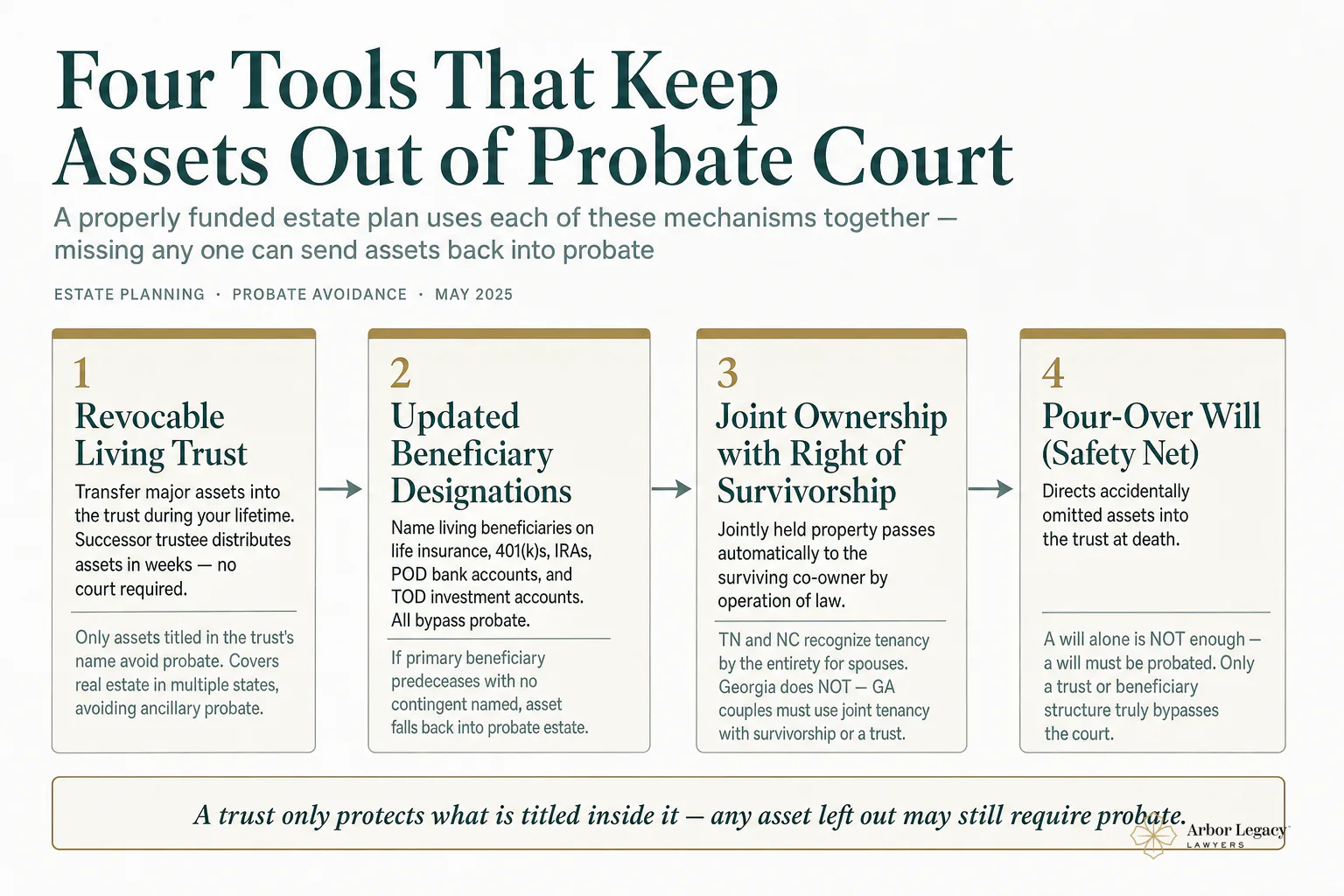
Life insurance policies, IRAs, 401(k)s, and other retirement accounts pass directly to their named beneficiaries outside probate (Justia). Payable-on-death bank accounts and transfer-on-death investment accounts work the same way, making them nonprobate property by design. The beneficiary designation on file controls, not the will. If a named beneficiary has died and no contingent beneficiary is listed, that asset can fall back into the probate estate. Review your designations after every marriage, divorce, or birth.
Jointly Owned Property and Survivorship Rights
Real property and accounts held in joint tenancy with right of survivorship — a form of joint ownership — pass automatically to the surviving owner. In Tennessee and North Carolina, tenancy by the entirety gives married couples that same automatic transfer, and in North Carolina such property is generally shielded from the individual creditors of one spouse (N.C. General Statutes Chapter 41, Article 5). Georgia does not recognize tenancy by the entirety (Georgia Title), so married couples there rely on joint tenancy with survivorship or a trust. But adding an adult child as joint owner of real estate — creating joint property with its own risks — can trigger gift tax issues and expose the property to that child's creditors. These are among the essential strategies for protecting your family's assets.
Assets Held in a Revocable Living Trust
Property transferred into a revocable living trust is titled in the trust's name, not the owner's. When the creator dies, the successor trustee distributes those assets privately under the trust terms with no court supervision (Justia). An unfunded trust does not avoid probate. Funding the trust matters just as much as creating it.
How to Keep Your Family Out of Probate Court With a Real Plan
Estate planning that keeps families out of court starts with arranging assets so they never become probate property in the first place.
The Revocable Living Trust as the Foundation
A properly funded revocable living trust keeps virtually all of a family's assets out of probate court. It operates as a private contract between the creator and the trustee, so the successor trustee can settle affairs in weeks rather than the many months a court process takes. For families who own real estate in more than one state, a trust avoids ancillary probate, a separate court proceeding in every state where the property owner held title. The trust also manages assets if the creator becomes incapacitated, something a will can never do. To understand the stakes, read how a founder sold his company for $1.2 billion and died without an estate plan.
Pour-Over Wills, Beneficiary Updates, and the Full Picture
No trust-based plan works alone. Life changes — marriages, divorces, births, deaths, and shifting assets — mean that a plan built for a young couple rarely fits that same couple twenty years later. That is why our Life & Legacy Planning model is an ongoing relationship, not a one-time transaction; we revisit your plan as your life evolves. The legal documents that come out of that relationship — a pour-over will to catch any asset the trust accidentally missed, updated beneficiary designations, and healthcare directives and powers of attorney — are the byproduct of knowing your family, not a checklist you complete once and file away.
Why Kids Protection Planning Belongs in This Conversation
For parents of minor children, probate is not only about assets. Without legal guardianship documents in place, a court decides who raises your children, and that process can be contested and painful, as one death, one courtroom, and one child taught every parent a hard lesson. Kids Protection Planning names guardians and backup guardians and creates a plan that can be activated immediately, without court delay.
How Much Probate Costs and How Long It Takes in These States
Probate's real price tag surprises most families.
Attorney Fees, Court Costs, and the Total Bill
A 2025 analysis found the total cost of probate typically runs 3% to 8% of the total value of the gross estate for a medium-size estate (FH Funding). On a $500,000 estate, that is $15,000 to $40,000 in legal costs and probate fees before the family sees a dollar. In Georgia, which bases fees on a percentage of money coming in and going out of the estate, total legal and court fees on a $500,000 estate commonly land between $8,000 and $20,000 (FH Funding). Federal estate taxes are not a concern at this level, since the federal exemption sits at $13,990,000 for 2025, rising to $15,000,000 in 2026 (IRS). None of the three states impose their own estate or inheritance tax, so community property rules and state-level transfer taxes are not a factor here. Tennessee repealed its inheritance tax effective January 1, 2016 (Higgins Estate Group), Georgia eliminated its estate tax after July 1, 2014 (Georgia Department of Revenue), and North Carolina imposes no state inheritance tax (Cary Estate Planning). For more, see how estate planning can reduce the high cost of dying.
The Timeline Problem of Months to Years of Delay
Probate freezes assets while the process runs. Family members cannot sell the house or access accounts until the court authorizes it. Straightforward estates in Tennessee generally take 6 to 12 months (SwiftProbate), North Carolina estates commonly close in the same window (Griffin & Schaefer), while Georgia typically runs 12 to 24 months (Probate By State). Property carrying costs during that wait can reach $1,000 to $3,000 a month, so an 18-month probate can drain tens of thousands in upkeep alone (FH Funding).
The Privacy Cost Most Families Do Not Expect
Probate is public. The will, the asset inventory, the debts, and the names of beneficiaries — including loved ones who may prefer privacy — all become part of the court record that anyone can read. A trust-based plan stays entirely private, with no filing and no public disclosure.
What Happens to Your Family If You Do Nothing
Doing nothing is still a choice. It just hands your decisions about the decedent estate to the state.
The Default Plan Is the State's Plan
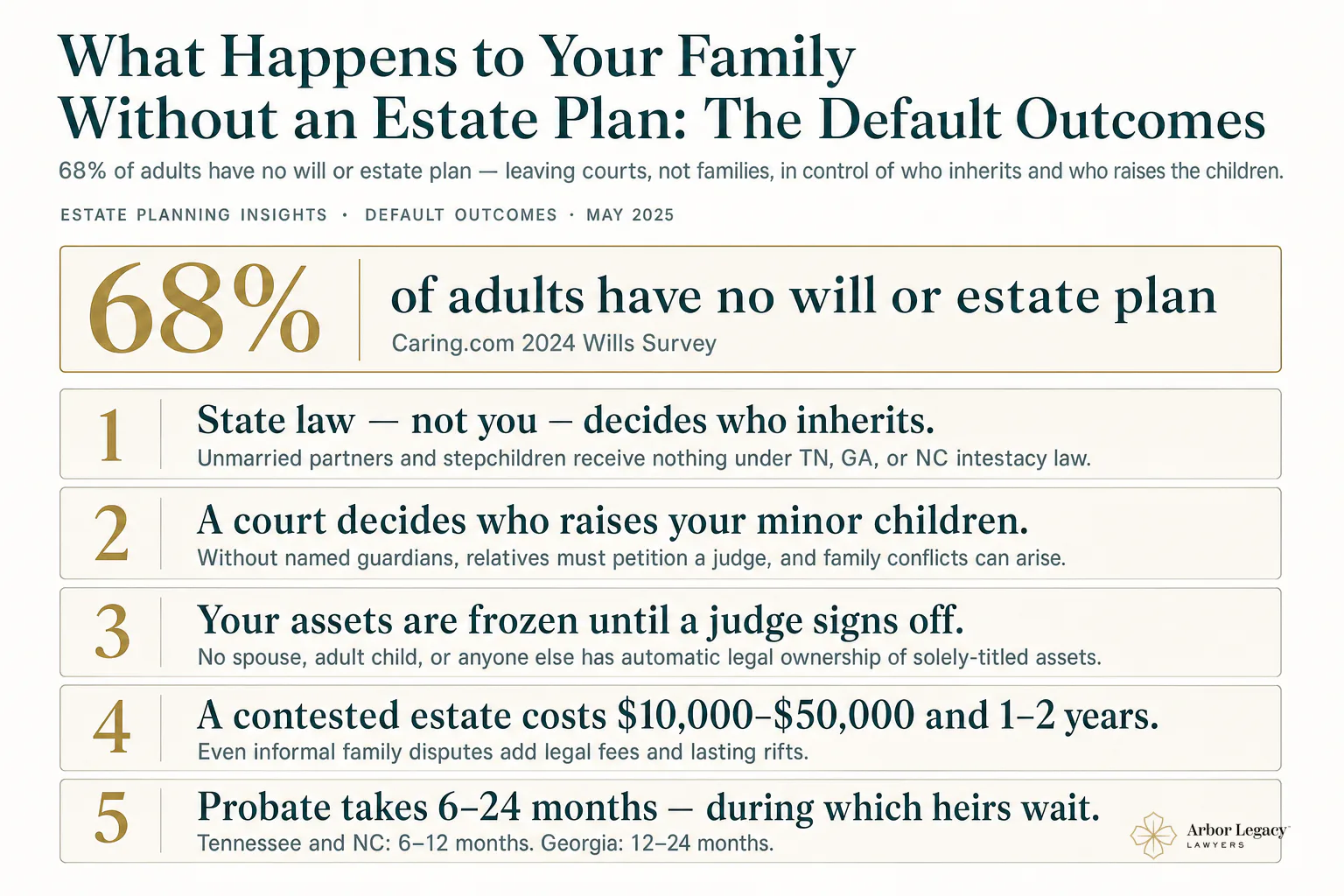
Without a plan, or with only a will, state law — not decedent death wishes — becomes your plan. An unmarried long-term partner or a stepchild you never adopted may receive nothing under intestacy, even if they were among your closest loved ones. A family home may have to be sold to satisfy competing claims among siblings. The court decides, not the family, and the results rarely match what the deceased person wanted, as Hulk Hogan's estate teaches about failed planning.
The Emotional Cost on Top of the Financial One
Roughly 68% of American adults have no will or estate plan at all (Caring.com), which means most families are pushed into probate by default. A typical will contest can cost $10,000 to $50,000 and drag on one to two years (Consumer Reports). The good news: a properly funded trust eliminates the conditions that breed these disputes, because assets held in trust never pass through the court at all. Even without a formal fight, siblings become co-parties in a court proceeding, and a grieving spouse manages court deadlines instead of healing.
The Good News Is That Getting Started Is Not Complicated
The tools that avoid probate — trusts, current beneficiary designations, properly titled accounts, and Kids Protection Planning — are not reserved for the ultra-wealthy. Arbor Legacy's Life & Legacy Planning model makes this level of planning available to every family, with transparent, no-surprise pricing and an ongoing relationship that grows with you. The hardest step is simply deciding to begin. Probate avoidance is not a luxury. It is estate planning every family with people they love deserves.
Frequently Asked Questions About Probate Requirements
Who is exempt from probate?
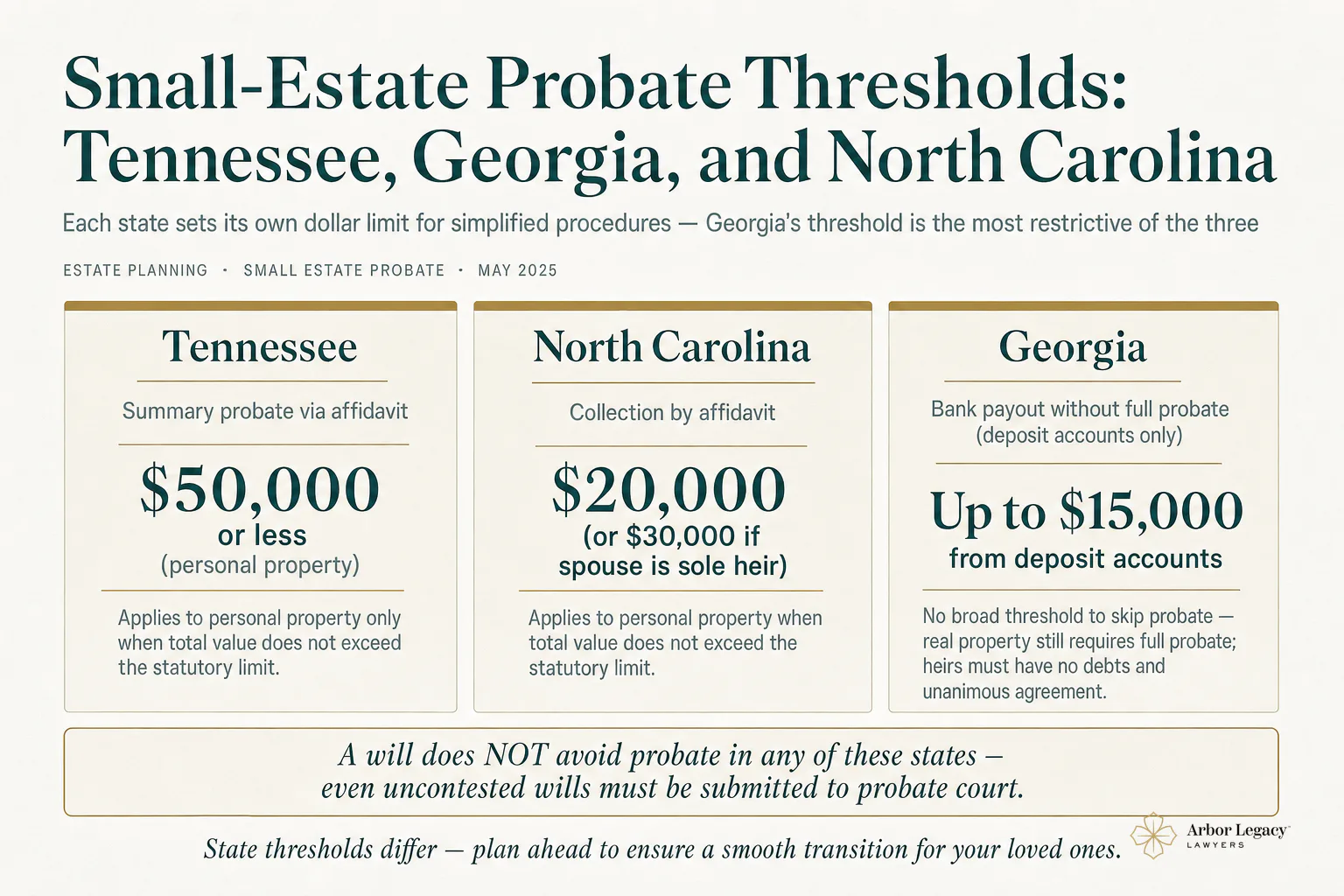
No individual is automatically exempt, the real question is which assets are. Assets with a named beneficiary, jointly owned property with survivorship rights, and assets held in a trust pass outside probate regardless of estate size (Justia). Very small estates can also skip full probate, such as North Carolina's affidavit process for estates under $20,000, or $30,000 when the spouse is sole heir (Carolina Family Estate Planning). Tennessee offers a similar pathway for personal property of $50,000 or less, including other property that does not require full court administration.
How do you know if probate is necessary?
Inventory everything the deceased person owned and check how each asset was titled and whether it had a named beneficiary. Understanding when is probate required comes down to a simple test: if solely owned assets above your state's small-estate threshold exist, probate is almost certainly required (Justia).
What assets typically do not pass through probate?
Life insurance and retirement accounts with named beneficiaries, payable-on-death bank accounts, transfer-on-death investment accounts, jointly owned real property with survivorship rights, and any asset held in a revocable living trust all bypass probate (Justia).
Who is first in line for inheritance?
With a valid will, the named beneficiaries inherit as directed after debts and taxes are paid. Without a will, state intestacy law controls, and the surviving spouse and children are first in line, followed by parents, siblings, and more distant relatives (Tennessee Code § 31-2-104, Pierce Law Group).
Can an estate be settled without probate in Georgia?
Yes, in some cases. Georgia offers simplified procedures for qualifying small estates, and assets held in trust, jointly owned with survivorship, or carrying beneficiary designations never enter probate (Georgia Department of Revenue). Larger estates with solely owned real property often require full administration, though Georgia's "no administration necessary" procedure can transfer property, including real property and digital assets where applicable, without full formal probate when all heirs agree.
Your Family Deserves a Plan That Keeps Them Out of Court
Without a plan, the court process, not your wishes, controls what happens to estate property you have built and, for parents, who raises the children you love. Probate is slow, public, and expensive, and it plays out while your family is grieving. It is also almost entirely avoidable. What is truly at stake is not just the dollars — it is the values you lived by, the stories you want passed on, and the relationships you spent a lifetime building.
Arbor Legacy Lawyers works with families across Tennessee, Georgia, and North Carolina, from Chattanooga to Alpharetta to Franklin TN, to build trust-based estate plans that keep families out of court and out of conflict, protect minor children through Kids Protection Planning, and grow through an ongoing relationship that updates as life changes. The firm also advises on elder law planning, special needs planning, business planning, and real estate matters — because a complete plan accounts for every dimension of a family's life, not just what happens at death.
The next step is a simple conversation — legal help is closer than most families think. Get started with Arbor Legacy Lawyers with a Life & Legacy Planning Session where we look at what you own, what matters most to you, and what your family would face without a plan in place.
This article is a service of Arbor Legacy Lawyers P.C. and is provided for educational and informational purposes only. It does not constitute legal advice and does not create an attorney-client relationship. Estate planning laws vary by state; consult a qualified attorney about your specific situation.
Kacie Gamble Tym****, Mother & Estate Planning Attorney, Arbor Legacy Lawyers P.C.